Saturday, July 4, 2009

JEANNE McLEISH, GUEST ARTIST

Guest Speaker/Artist

Joan Miley introduced our guest artist, Jeanne McLeish. Jeanne was born in Clinton, Indiana, and began painting in 1970. She works in both transparent watercolor and oils, and she is a signature member of the Transparent Watercolor Society of America. She owns and operates Color Works Custom Picture Framing Gallery in Mooresville, Indiana, where she resides. You can view her work on her webpage at
http://www.home.earthlink.net/~burkettmcleish/

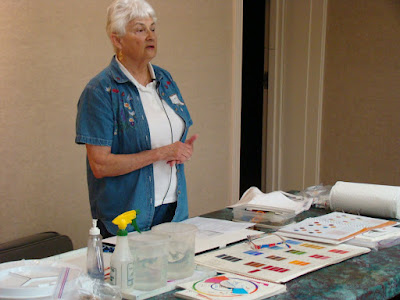
Today, Jeanne led us through her process from drawing to final painting of an Italian landscape, including several figures in the scene. Jeanne said she always begins her paintings with a very tight, very detailed drawing. She wants to be sure she has a good foundation before she even begins to put paint to paper.

Before she paints, she thinks about several things, including:

Layers – how many layers will this painting have?
Since she doesn’t use the white of the paper, how will she cover the paper. This means toning the paper with a pale – usually yellow – underpainting.
Where should she leave the pale colors showing to depict sunlight?
Where will the darkest colors and values go, and what colors will be used for the shadow shapes. Also, will the shadows be warm or cool?
Jeanne said you have to paint big – half sheet or larger – when you put figures in a landscape painting - or else the figures look like ants on the paper.
Planning her painting includes working with a good 8 x 10 color photograph, making an 8 x 10 B+W copy of that photograph, and then creating a value study or a full drawing. Her husband built a large lightbox for her, so she can trace her drawing onto the watercolor paper without redrawing the whole thing. Since she likes very detailed drawings, that has saved her hours in the planning stage. She does still make a chart of where each step/layer will be in the painting. So her tip to us is “Be mindful!” Think about the values in your painting, the color temperatures and how they change, and remember you are painting shapes. Other things to think about is how you will tie the design into the painting; where you will have the painting go off the edge; and how you will move the viewer’s eye through the painting.

The 140# watercolor paper was stapled to a piece of Gatorboard. Jeanne prewet the paper, and began her painting using the transparent triad of Aureolin yellow, Rose Madder Genuine, and Cobalt Blue. She begins with yellow, laying that down wherever the sunlight is going to show in the painting. Since this was a painting of Italy, there was a lot of sunshine!
As she moves away from the sunlit areas, she starts painting with the Rose Madder Genuine. She uses RMG next so she has the option of making the mix either warmer or cooler, depending on how much of the RMG she uses. She puts in the Cobalt Blue later when she wants to give a cool color to an area. Each color she put down, she kept very pale as this was her “first pass” over the painting. She dried the paper with a blow dryer before moving to the Cobalt Blue sky area, saying it had to be bone dry before glazing the sky color. She wasn’t worried about putting Cobalt Blue over Aureolin in the sky areas because she wanted to capture the blue-green color of the Italian sky.

When thinking about painting the buildings, Jeanne said she can add in opaque colors at this point since she wants the buildings to have a density and substance. However, don’t try to glaze two opaque colors because the resulting color can quickly become too dense and muddy looking. You can put down one opaque color and then layer over that with a transparent color, and not worry about anything becoming too opaque. Jeanne built up pale washes on the buildings, keeping the warms and pales where needed; she reminded us that you work from big shapes to small shapes, saying, “First the dog, then the fleas!”

Jeanne worked with a No. 20 Winsor Newton Scepter Gold round brush and a large flat brush throughout the painting. She had her colors separated into three trays so the colors would remain clean: Aureolin in one tray, Rose Madder Genuine in another, and Cobalt Blue in the third. When she mixed colors for shadow shapes, she mixed a transparent orange in one tray, and a transparent red-violet in another tray. She allowed the paint to mix and blend on the paper, especially when she added Yellow Ochre (an opaque) and Cadmium Yellow (another opaque). She continued to glaze over the first pass of pale colors until she got the values she wanted and the colors she wanted throughout. When she put cools in the shadowed area of the street and foreground, she added Cobalt Turquoise to her mix of colors, darkening the foreground but leaving some areas that reflected the sunlight on the cobblestones.

As Jeanne painted, she tilted her board, causing the paint to run and blend, dropping in the colors on the paper. She said what she likes is “color flowing into color flowing into color,” and you could see that result, especially in the shadows. It was a beautiful, sunlit scene with rich, transparent shadows.

Jeanne had a finished, matted painting for us to see the final stages since she didn’t finish her demo today. She pointed out the women in the painting and how their bodies and gestures told a story. Apparently, these women were having a heated conversation, with much gesturing…so Jeanne called this painting Arch Rivals!

Critique Session

Jeanne critiqued five paintings. As she viewed the paintings, she talked about using color to convey a mood. She mentioned tying your colors together to create harmony. She talked about landscape painting, and how the sky needs to be the lightest thing when painting a sky and water scene. She turned one painting upside down to prove this point.

Jeanne reminded us to keep foliage masses varied in landscapes. She said still lifes should have good, varied, colorful shadows, not just flat, gray shadows. A shadow will be the color of the thing plus a touch of warmer or cooler color but never just more color added to dull it down by using the complementary color over the base color. Shadows may also show reflected colors from the main objects casting the shadows.

Howard Krauss brought in a painting he did in the Tom Lynch workshop. Jeanne said she wished she had painted the sky, which was beautiful with lovely peach colors in the clouds. She did recommend he lighten a post on the pier to cause the eye to go to the boat on the dock, which Howard said was supposed to be the center of interest.

Marilyn Bishop brought one of her bright, abstracted pieces painted with watercolor crayons. Jeanne said she had a beautiful design and a great division of space. She noted that, if she was going to nitpick, she’d tell her she had two paintings, not one: one was a half orange/half blue complementary study and one was a half green/half red complementary study.

Paint-Along

Jeanne stayed after the meeting to lead a paint-along, sharing more of her watercolor technique and planning process. She handed out information sheets with “seven things to think about before you begin to paint.” These seven things included thinking about what you are going to paint and why you want to paint it; making sure you’ve chosen the appropriate point of view for your particulate interest; planning an effective composition which leads the viewer’s eye into, around, and throughout the painting; and making a value study to be certain your value pattern strengthens your design.

Administration Reports

Shirley welcomed us all, apologizing for the delay in starting the meeting. Due to the closure of I-75, our guest artist was delayed as she tried to find her way around I-75 this morning.

As we waited , Shirley shared these words:

“Artists have their ups and downs…for a while, everything you do is wonderful…or you think it is…then you slide down…pulling yourself up again is the most important part of your life.”
Milton Resnick (1917-2004)

Membership

Our only guest today was Jane Navarro. Jane is an art school graduate. She owned her own interior design business for years, and was recognized by members from her decades as a docent at the Cincinnati Art Museum.

Evergreen Spring Show

Deb Ward gave the final report on the spring Evergreen show, noting that 47 members entered 90 paintings in the show, with sales by Donna Cameron, Sally Wester, Leonard Williams and Deb. She thanked Marily Bishop for suggesting the theme of “Seven Year Itch” and the “Find the 7” game at the opening reception. Although the opening was not highly attended, we appreciate participation by members who gave painting demonstrations on weekends, including Sam Hollingsworth, who gave a special Sunday lecture on planning a painting. John Ruthven donated the price of his special talk to our scholarship fund, which was greatly appreciated.

The income from the show was $470; the expenses for the show were $460.74; unfortunately, that means we made less than $10.00 on the show. The scholarship fund did receive money from the Ruthven event.

Leadership Positions

Shirley reported that the nominating committee of Vicki Shepherd, Jane Hittinger, and Rhonda Carpenter will be asking for nominees for the positions of President, Program Chair, Recording Secretary and Facilities Manager. All of these positions need to be filled by March 2010. We will vote on those positions/nominations this fall. If you are willing to put your name forward for any of the positions, please let one of the committee members know.
You may be contacted by one of the committee members. Please step up and become a truly active member of the group, working behind the scenes to make the GCWS a very successful watercolor society!

Shirley reminded us that Sharon Roeder is our Publicity Chairperson. Any member who is having a show or who has won an award should send that information to Sharon.

Summer Sizzle Give-away

Continuing our Summer Sizzle, we had another surprise give-away of art supplies. Today’s winner was one of our newest members, Audrey McKinney. Audrey won an Arches Travel Journal and three tubes of DaVinci watercolors in primary colors.

We will do one more Summer Sizzle give-away, so come to the August meeting and see if you are the lucky winner of some very nice art supplies!

Misson Statement Review

Marilyn Bishop asked for one volunteer to help her revisit the GCWS Mission Statement as it pertains to exhibits and other aspects of the group. She read the mission statement:

“Formed in 2002, the society encourages the creation of watercolor at all skill levels and promotes interest, appreciation and enjoyment of watercolor and watermedia.”

The 2-person team will create a survey that will be sent to all members, asking questions about where we are going, what we want the GCWS to become, and how we are currently achieving our goals – and how the exhibit/show fits into that. Marilyn stressed that we are not suggesting stopping the Evergreen show but perhaps finding places with more traffic. Nancy Wisely volunteered to help Marilyn.

DVD Library

Marilyn reminded us to take advantage of our DVD library by signing out any DVD you want to watch. All you have to do is return it the following month. If you have any ideas for future DVDs, let Marilyn know.

Remaining 2009 Programs/Guest Artists

August – Donna Clark, Ohio Watercolor Society member, will demonstrate painting with liquid watercolors. She will provide the paints if you will bring a small piece of matboard on which to paint in the paint-along after the program. See Donna’s paintings at:
http://fineartamerica.com/profiles/donna-clark.html

September – If you were lucky enough to attend the meeting when Jean Vance (
http://www.jeanvanceartist.com) gave her Oriental Brush Painting talk and demo, you know how interesting this artist is. However, you may not know that she is a versatile artist and teacher. So come along for this meeting and watch as Jean paints a more traditional watercolor painting for us and discusses her process.

October – Ken Bowman, of Bowman’s Framing in Ft. Thomas, KY, will be here to discuss how best to mat and frame your watercolor paintings to show them off to the best advantage. Ken will also give any member personalized advice on any painting brought in for his viewing. The painting should be unmatted and unframed. After Ken’s talk, we will have our annual sale of gently used art supplies, books and videos/DVDs. Please bring small bills and coins to the sale if you intend to purchase or sell something.

November – Judy Anderson makes a repeat performance with something new, bright and bold to share. You can visit Judy’s webpage at
http://www.artbyanderson.com .

December – Marilyn Bishop will give a demonstration and talk on watercolor monotype printing. You can do this without investing in a printing press so come and learn a very interesting and wonderful new watercolor technique to add to your repertoire!

Monday, June 8, 2009

LEONARD WILLIAMS - GUEST ARTIST

Guest Speaker/Artist

Shirley introduced our guest artist, a long-time member, Leonard Williams. Leonard’s love of nature shows, not only in the name of his studio – Broken Antler Studio – but in his realistic depiction of natural scenes. He teaches both beginning and intermediate watercolor classes close to his studio in the Dayton, OH area. He has shown his work in local and national shows, and has won many awards. His paintings can be seen in galleries, on his web site at (
http://www.brokenantlerstudio.com), and in two of Nita Leland’s books, Exploring Color and Confident Color.

Leonard began as a sign painter and worked in that field for 35 years before taking up watercolor painting. He described himself as mostly self-taught but said he did take watercolor workshops from Nita Leland and Stephen Quiller, spending one week a year in Montana landscape painting, and learning. He learned how to work with casein paint from Stephen Quiller in Colorado.

Casein, by the Shiva company, is an opaque paint, used by illustrators since the 40’s. It is making a resurgence lately with a few of our members. It holds up forever, dries to a flat finish, and needs no glass to protect it when framing. Len uses a spray fixative, then paints acrylic matte medium over his pieces to hang them without glass. He brought a few finished pieces to show us the depth one can get with casein, and how it dries to a very matte finish.

Leonard had done a detailed drawing of the scene he was going to paint for us today. He normally does not do such a complete drawing before painting, but he loves to draw so he created this in addition to the painting. For the painting itself, he began with just a pencil line drawing on watercolor board (a sheet of cold press watercolor paper glued to a board from the Strathmore company). You can use watercolor paper, watercolor board, or illustration board when painting with casein. Casein pigments are completely opaque, but you can thin them down a lot with water, although you’ll never get the transparency of watercolor with casein paints.

Leonard had already started his painting with an underpainting of Alizarin Crimson and Cadmium Yellow. He painted over this with a variety of greens, blues and purples. When painting with casein , he begins with the dark colors and puts the light colors in last, like painting with acrylics or oils.

Placing the green over the red (or the purple over the yellow) allowed the underpainted color to peek through in places, giving the painting more visual interest. Leonard said he often layers his complementary colors this way, and he likes to tone his paper with color before really starting, only because he doesn’t like starting with stark, white paper. Leonard didn’t finish this painting but had other finished ones to share with us. He said he enjoys working with casein because you can fix and change things as you go without fear of getting muddy colors. Using the same tools in casein as you do in watercolor (water to thin and mix the pigment, and watercolor or acrylic brushes), you still have to realize you cannot reconstitute casein with water like you can with watercolor. Once you put casein out on your palette, you have to use it or it dries up and becomes unusable in just a few days. It doesn’t dry so quickly that you are rushed for time to work on a painting, so you have a day or two to finish a casein painting before you have to start with fresh paint from the tube. Leonard stressed that you must clean your brushes thoroughly with soap and water or you will ruin a brush once the paint dries inside it.

It is always fun to see different water media, and casein is an interesting possibility for those who want to expand from pure watercolor. We appreciate Leonard taking time to share casein painting with us today.

This painting of Len’s was from Old Man’s Cave in Hocking Hills, OH, one of his favorite places to go locally for plein air painting.

Critique Session

Leonard agreed to lead the critique session today. We had 3 paintings from members who needed just a bit of help with their unfinished pieces.

Paint-Along

Len stayed to lead the paint–along program, sharing his casein paints. Several members stayed to learn more about his technique with this medium. They painted small paintings on watercolor board or their own watercolor paper. Leonard asked that all who try casein at home bring in their paintings at the next meeting for some more discussion and sharing.


Administration Reports

Shirley welcomed Mary Marxen back after her health scare. Mary talked a bit about what had happened to her, and recommends everyone living alone to get a LifeLine bracelet. She will now be wearing hers all the time. We were so happy to see her back and looking so well.

Shirley then shared the following inspirational words from Lynn Powers at Creative Catalyst:

“Every year around this time I find myself out in a field with a bit of paint and whole lot of frustration. For the other 9 months I am inside painting mostly portraits. It's hard not to meet these great landscape painters and think that there is something wrong with me if I keep myself locked up on such glorious days.

But then I am on that hill or next to that lake or under that tree and while the people and place are all pleasant, I can feel myself fighting my craft and myself. I keep thinking that I should like it more and frankly get better paintings out of the experience. But then I start to consider what I've heard a few CCP artists say. George James described himself as a studio painter. I had never heard someone make that distinction. Shirley Trevena said in her latest video Breaking the Rules of Watercolor that she works on a painting for weeks, sometimes months, before she is done. Certainly she is not out in a field the entire time. She too would perhaps classify herself as a studio painter.

So would I. I am a studio painter. I need time and quiet for my work. But it makes me realize that as a studio painter, I really do love painting plein air but not because of the finished painting. I like it because I pack a tasty snack and enjoy the view and the company of my fellow painters.

This coming week as I make my way outside I will acknowledge what I love about plein air and also pay attention to all the same issues that are important to me in the studio. I'll try to stay focused and optimistic. I'll step back and think about what I'm doing. I will work on not feeling rushed. And maybe I'll pack a few extra brownies, because art is weighed on more than just the finished piece but also the experience of spending a day trying something new.”


Membership

Jane welcomed one guest today, Gaylynn Robinson. Gaylynn found out about the GCWS from Deb Ward. She has been painting in watercolors for about 9 years after starting with oils and an Art Education degree. She said right now watercolor is a hobby since she only gets to paint when her job doesn’t keep her otherwise occupied.

Leadership Positions

Shirley reported last month that there are several positions in the club that will be open March 2010. She passed around a sign-up sheet for volunteers to be on the nominating committee.

Evergreen Spring Show

Shirley reported that the Evergreen show ended with 4 paintings sold.

Springtime Art Shows/Honors

Wyoming: Taylor Bush received 2 honors at the Wyoming Art Show, winning the Pat Painter Award and receiving 2 ribbons for her portraits. Congratulations, Taylor, on a well-deserved honor!

Bethesda West: Marilyn Bishop had her art accepted into the Bethesda West Art Show. Marilyn is expanding her venues to include many new arenas for her work. (She shared 2 paintings she had done today before today’s Critique Session, both painted in the Barbara Smucker style; they were lovely and bright with soft edges and a romantic look to them.) Susan Grogan also had work accepted into this show. Congratulations, Marilyn and Susan!

Susan Grogan announced that the Queen City Art Club invited us to join them for their 1st Friday gallery hop in Covington, KY. If interested in joining in, ask Susan about meeting time, place, etc.

Before announcing the guest artist/speaker, Shirley said, “This is the time of the Summer Sizzle. Remember those words for later!”

Summer Sizzle Give-away

For the summer months, we will be doing a surprise give-away of some art supplies. We’re keeping the technique of how the winner is chosen a secret – you’ll just have to attend a meeting and see how it works! Today’s winner was Jan Hay and she received a little goodie bag of art supplies: a pencil, an eraser, a tube roller and a little travel palette already filled with watercolors and containing a small water bottle – perfect for any plein air adventure! Jan said she was going to make this her plein air watercolor kit and take it with her on her next trip away from home. Congratulations, Jan!

Who will win next month and what will the goodie bag hold? Join us in July, and see for yourself!

Programs/Guest Artists Scheduled

July – Jeanne McLeish, transparent watercolorist, will be the guest artist and speaker. You can view some of her work at:
http://www.home.earthlink.net/~burkettmcleish/

August – Donna Clark, OWS Member, will give a demonstration and talk about her style of watercolor painting. You can get a sneak peek of Donna’s paintings at:
http://fineartamerica.com/profiles/donna-clark.html

September – Jean Vance (
http://www.jeanvanceartist.com) returns to share a different technique with us.

October – Ken Bowman, of Bowman’s Framing in Ft. Thomas, KY, will be here to talk to us about matting and framing. We will also have our annual flea market sale of gently used art supplies and books/videos in October.

November – Judy Anderson makes a repeat performance with something new, bright and bold to share. You can visit Judy’s webpage at
http://www.artbyanderson.com .

Saturday, May 9, 2009

BARBARA SMUCKER, GUEST ARTIST

Guest Speaker/Artist

Joan Miley (Programs) introduced our guest artist, Barbara Smucker. Barbara was an art major who put her art on hold after graduation in order to earn a living and raise a family. She now shares a studio at the Pendleton Art Center in Cincinnati.


Barbara doesn’t describe herself as a professional or an expert, but as a fellow painter who offers her own journey. She said she always feels lucky to be an artist and to be in the company of artists.

Barbara has experimented with different mediums, beginning her watercolor journey when her husband signed her up for a weeklong workshop through the Hudson Valley Art group where she became a student of Skip Lawrence. She studied with Skip for 10 years, each year taking the 1-week workshop with him to learn more. She has also taken other lessons and workshops locally.

When she first started painting, her goal was to “paint a good one,” so she focused on technique. She thinks that sometimes we get stuck in technique and lose the creativity of art. She thinks you should be able to put yourself in a creative place in order to make great art. With this in mind, she read to us from the children’s book, The Big Orange Splot, by D. Manus Pinkwater. She said this was what learning from Skip Lawrence was like. The refrain was: “My house is me and I am it, and my house is where I like to be, and it is the place for all my dreams.” Barb said you should change your house to fit your dreams – same thing with your art. Change your art to fit your dreams, your goals, your emotions – share who you are, not what you can do technically. We need to translate our dreams into our paintings. And in order to do that we first need to discover what we care about.
Do we love color? Texture? Do we have a personal message to share? During his workshops, Skip had his students paint an emotion. Have you ever tried that? What colors would you use to portray the emotion you chose?


Barb had several of her paintings on the easels and around her, and it was clear that she is a colorist. Color is the thing that excites her as an artist. Knowing that, she tries to use color to make her paintings more personal. She talked about color and color choices and how to personalize color in your paintings. But first she passed out a sheet on a simple and elegant design principle, taken from an article in The Palette Magazine, Issue 5, called A Lot of This and a Little of That.


What that means is you should start your painting with the thought: "What will I have a lot of and what will I have a little of in this painting?"


She compared this to Pierre Bonnard paintings where he has painted a room in gorgeous, sensitive color and then has a little black dog in the corner of the room – the room is a lot and the little black dog is a little. Skip Lawrence actually calls this idea “the dog” because of Bonnards inclusion of the little black dog in many of his paintings – the little something in the lot of something.

A Lot: the repetition of a visual quality in your painting, a color, a texture, the direction of lines, brush strokes, marks, light or dark values, temperature, etc. A Lot of something makes your painting read as a whole. It gives it unity and cohesiveness.


A Little: the contrasting element, the complementary quality that spices up your painting and gives it excitement and interest. The “dog” in the corner of the room! You should think about A Lot and A Little when composing and when critiquing paintings.

Barb said when she was a beginner, she made her color choices based on the local color she could see. If it was a red apple, she got out her red pigments and painted the apple with those colors. But after a while, she realized she could use color in other ways. She shared handouts with the following information on a variety of approaches to use when choosing color.

1. The Traditional Approach: Value as a Color Choice
With this approach, the artist bases color decisions on a value pattern; uses a full range of color values from light to dark; and squints a lot to see the values. This artist establishes a color dominance and uses the push/pull of warm and cool to create space and sculpt shapes. Rembrandt, Edward Hopper, and Andrew Wyeth are all Value Painters.

2. Pure Hues as a Color Choice
With this approach, the artist depicts emotional exuberance, happiness, joy; uses color straight out of the tube; uses pure, bold color; and uses a neutral gray, black or white against the pure hues to make the pure colors shine even more. Vlaminck, Derain, and Kandinsky are all Colorists.

3. Color Intensity as a Color Choice
This artist depicts mystery, passion, hope, thoughtfulness, sunsets, dawns; pays attention to the relative purity or brightness of a color, using mostly grayed or “dirty” colors against “clean” colors, placing pure hues only in the focal area. JMW Turner, Wolf Kahn, Emile Nolde, and Kay Hurley are Color Intensity painters.

4. Tones and Shades as a Color Choice
This artist depicts ideas or emotions that cause you to look at the paint quality/texture of the subject. There is often a softness or lushness to that quality. This artist uses color mixed with whites or complements consistently throughout the piece. Pastels work well for this. Tonalists are Gaugin, Monet, Renoir, and Rothko.

5. Complementary Colors as a Color Choice
This artist uses colors which are direct opposites on the color wheel, creating a visual vibration when used as pure hues. Consider using “visual complements” like red or magenta with turquoise or blue-green, using yellow with blue, or using cyan with orange. One of the most famous complementary colorists is Vincent Van Gogh who said, “I am always in hope of making a discovery…to express the love of two lovers by a marriage of two complementary colors, their mingling and their opposition, the mysterious vibration of kindred tones.”


Barb talked about how her goal in painting is to share emotions and feelings she has. She says she doesn’t want to paint a place, but paint how she felt when visiting that place, giving an example of the 20th anniversary trip she and her husband took to France. When she returned she had paintings that were not about the places she saw but were about the light and the colors that infused the villages and people there.


She also is making contact with her history in the small quilt-type paintings she is doing now: abstracts that have the same lines and blocks of color a quilt would have. She said, “being a Smucker from Ohio with a Mennonite background, there were a lot of quilts in my background.”


Barbara gave us a lot to think about when choosing colors for our own paintings in the future. She then began a short demo of how she uses opaque watercolors in her paintings. She uses mostly Cheap Joe’s American Journey paints because they are inexpensive (she uses a lot of paint in her technique) and have a nice opaque quality. She mentioned Coastal Fog as one she likes to add to paintings over a warmer underpainting.


Starting with her paper (140# coldpress) taped to a board, Barb started with bright, warm, full intensity colors, putting them on the paper in a scrubbing motion with bristle brushes. You could hear the bristles scratch the paper as she worked, really pushing the pigment into the paper. She prewet her brush (not the paper) and then wiped the excess water off with a towel so her brush was just a bit damp as she worked. She did not prewet the paints in the palette but did add fresh paint to one color that was too hard to manipulate.

The demo, an abstract, was going to be about prayer: the peacefulness and underlying energy of prayer. Barbara said she begins each painting with an an emotion. Then her goal is to SIMPLIFY (which is not always easy to do). The warm yellows, oranges and maroons she first put on the paper were to reflect the power and energy of prayer. The American Journey color, Coastal Fog, she put down over the bright, warm colors, toned everything down and reflected the peacefulness and silence of prayer.


It was very interesting to see watercolor paint used this way. Barb said she always begins with a pure, clean color and then grays it out as she works on the painting. Following Skip’s teaching, if she puts a color on that does not work right away and she knows it, she does not continue to add touches of that color throughout the painting to make it work – instead she wipes back to the underlying color right away. She did this when she placed some dark Brown Derby color on the paper and didn’t like it, lifting it back down to the underlying color.


Barbara didn’t have time to finish the painting, but ended the session by telling us, “The more you look at art, the better you will become at making art personal.”


Critique Session

Barbara led the critique session for the single painting shown today. It was a lovely, delicately painted seascape using beautiful, harmonious colors throughout – an excellent example of setting a mood or evoking an emotional response in a painting.

Administration Reports

Shirley welcomed us and shared the following quote from the Creative Catalyst website:

"Things are not difficult to make; what is difficult is putting ourselves in the state of mind to make them.” Constantine Brancusi 1879-1957


Shirley then introduced our 2009 Scholarship Recipient, Bryan Davis. Bryan is a graduating senior from Winton Woods High School and has plans to attend Wilmington College in the fall. Bryan not only has a passion for art but is athletic, competing in track and football. He shared three of his paintings with us, talking about his motivation, his class requirement for the paintings, and his goal for each one. Bryan works well in a variety of mediums and we are very pleased to award him the $500 Scholarship this year. He was so comfortable in front of the group, sharing his artistic experience; it was a pleasure to meet this young man.


Alice Fossett (Treasurer) gave the monthly report, saying the majority of members have paid their yearly dues so our coffers are full right now. She reminded the membership that this amount does have to last throughout the year for rental of the building, payment for guest speakers/artists, and show expenses. While it seems a large amount, it dwindles away by the end of the year after all the expenses have been paid.

Shirley noted that there are several positions in the club that will be open as of March 2010. We need to create a nominating committee to come up with names for the positions of President, Program Chair, Recording Secretary, and Scholarship Chair. Shirley will ask for three volunteers at the June meeting.

Evergreen Spring Show

Deb Ward reported on the progress of the Evergreen Show (April 26 – May 31). Although attendance for the opening was poor, we have sold three paintings. She reminded participants to pick up, or make arrangements to pick up, all paintings on June 1.

Deb thanked Marilyn Bishop for her suggestion to play the “Number Seven” game, which was a hit with the Evergreen residents and those who visited to view the show. They loved the game and the prizes, and it made them look closely at the artwork in order to find the tie-in with the number 7 throughout. Shirley also noted that the lecture given by John Ruthven was very well received and attended. Mr. Ruthven, at 84, is busier than ever and gave a great lecture.

Sharon Roeder reminded us of Sam Hollingsworth’s demo and
lecture scheduled for Sunday, May 17th at 2 pm. Please come and support Sam as he talks about the making of a watercolor painting from planning and preparation to completion. This information is on the blog, along with the schedule for all members who are doing demos during the show.

Membership

Deb Ward passed around a sign-up sheet for those members who want to return to receiving postcards as notice of upcoming meetings. She also had copies of the new members’ contact information that should be added to your membership directory to keep it up-to-date.

Springtime Art Shows

Queen City Art Club’s “Spring on Main Street” show (Chesterwood Village, 8037 Tylersville Road, West Chester) continues daily from 8 am to 6 pm through May 15.

The Stephen Blackburn workshop in Cincinnati May 15-16 still has some slots open. Contact Deb Ward for more information.

There are still spots open for the Tom Lynch workshop in June. Contact Howard Krauss if you want more information.

Deb Ward is teaching 2 classes at the Dunham Center and had handouts on the back table for more information on those classes.

Future Programs/Guest Artists

June – Leonard Williams will demo and talk about casein painting. He will have casein paints to share in the paint-along after the program. For those of you who don’t know Len’s work, you can get a sneak peek before the meeting by going to:
http://www.brokenantlerstudio.com

July – Jeanne McLeish, transparent watercolorist, will be the guest artist and speaker. You can view some of her work at:
http://www.home.earthlink.net/~burkettmcleish/

August – Donna Clark, OWS Member, will give a demonstration and talk about her style of watercolor painting. You can view Donna’s work at:
http://fineartamerica.com/profiles/donna-clark.html


Saturday, May 2, 2009

FREE ARTISTS' DEMOS

Greater Cincinnati Watercolor Artist Sam Hollingsworth Explores the Spontaneity of Painting Watercolor

In conjunction with the Greater Cincinnati Watercolor Society (GCWS) Art Exhibit “The Seven year Itch”, currently located at Evergreen Retirement Community,230 West Galbraith Road, GCWS member artist Sam Hollingsworth will be lecturing and demonstrating “The Making of a Watercolor Painting” Sunday, May 17th at 2:00 pm. Sam will describe the steps he takes to choose a subject and develop it into a completed watercolor painting.

There will be no admission charge. Free will contributions are accepted to benefit the GCWS Scholarship Fund.

Sam says” The issues facing the artist using a difficult medium requires certain steps be taken to achieve successful results. Planning, preparation and a willingness to work with the inevitable” surprises” make watercolor a wonderful and rewarding medium.”

The show is open daily through May 31st from noon until 5:00 pm with GCWS artists working on site each weekend (see below for schedule) presenting mini-demonstrations in watercolor.

The following artists will be painting demos at the times shown below. Stop by to enjoy watching a watercolorist at work at EVERGREEN RETIREMENT CENTER. More details on the sidebar.

DATE, TIME, & ARTIST'S NAME

Saturday, May 2, 12-4 --Sharon Roeder

Sunday, May 3, 12-4 --Lois Schaich

Saturday, May 9, 12-4 --Leonard Williams

Sunday, May 10, 12-2 --Joan Ammerman

Saturday, May 16, 12-2 --Susan Grogan & from 2-4 --Howard Krauss

Sunday, May 17, 12-4 --Sam Hollingsworth

Saturday, May 23, 12-4 --Joyce Friedmann

Sunday, May 24, 12-2 --Jo Hogan and from 2-4 --Mary Moore & Joan Abdon

Saturday, May 30, 12-4 --Shirley Knollman

Sunday, May 31, 12-4 --Marilyn Bishop

Thursday, April 2, 2009

COLORFUL JUDY ANDERSON

Guest Speaker/Artist

Joan Miley (Programs) introduced our guest artist, Judy Anderson. Judy’s program today was called “Working from Photographs: A Resource, Not a Religion.” She talked to us about using the photographs we take as guides to our final painting, but to realize that a single photograph does not always equal great art. She stressed that you “add your own orchestration” to the photo you take to compose it in the best way, making changes that will make a better painting.

Judy began by showing us how she uses a photograph for her final painting. She takes the photo to a copy shop and has it enlarged in black and white. She wants the black and white copy so she can make the colors of the painting hers, and not be a slave to the colors in the photo. Also, when she begins working on her painting, she is interested only in the main subject (the center of interest), not everything else around it in the photo. She stressed that you need “good bones” for a good painting so your foundation work - your photo, your black and white enlargement, your value study, and your compositional changes – are all creating a strong foundation to make a good painting.

Judy is famous for working with blocks of bold, bright color, whether she’s painting with pure watercolor or with gouache. She said she works with the five kinds of compositions:
1. vertical
2. horizontal
3. overall pattern (like a quilt pattern)
4. circular
5. cruciform
If she can take her basic subject matter and make it work in all five compositional elements, she knows she has a good painting. However, she suggested you start with just two or three shapes unless you want to give yourself a headache!

Judy’s motto is, “Think Twice, Paint Once.” She spends time creating a good composition from her photo before she ever puts paint to paper.

After the preliminary talk, Judy started the demo with a photograph taken in Italy of a building, and the enlarged black and white photo. Using a blue watercolor pencil, she drew the lines of the building on her watercolor paper, making changes as she drew. The watercolor pencil lines will wash off once she puts water on her paper. She didn’t want the painting to be all straight lines like the photo showed, so she curved some as she drew. She didn’t want so much blue sky showing in her painting, so she made another building behind the building in her photo reference, cutting into the sky. She was working with the shapes in the photo, not “a building with windows, doors, and a roof.” She said she wants to have “less photo, more Judy” in her paintings by making the photo more interesting and more fun. She believes it is her job to compose the painting and make it work for the viewer.

Judy began painting her finished sketch. If she puts down a cool color, she goes over it later to darken it with a cool color; if she puts down a warm color, she goes over that later with a warm color. If you mix cool and warm over each other, you get muddy color. She said she is constantly aware of the shapes throughout the painting, and she normally puts in her darks last.

Judy said it doesn’t matter what the color is, break it up so you don’t paint lots of solid color. Even in her blocks of color in this painting, she added orange to yellow and had three different blues in the sky. She prewet a block and put in color while the block was still wet. She used Arches hotpress 140# paper. She almost always uses hotpress paper for her work.

Judy uses a lot of colors, but suggested that the more difficulty you have with color, the fewer colors you should use until you are more comfortable. She always leaves white space around her painting in case she wants to add a design element in that space later.

When working with pure watercolor, you may need to put gouache over it in an area. If you do that, you have to repeat that gouache in several places in the painting so that one spot doesn’t look like you had to fix a mistake. Make it look like you planned to add it there!

Judy didn’t like the way the door was looking in the painting so she added dots to the shape to change the look. She said dots or some pattern can take a boring area and make it more interesting, and you can tell from many of her paintings how much she loves patterns and textures.

When her colors butt up against one another, she makes sure to vary colors from cool to warm to cool, constantly varying the temperature of any colors right next to each other. This makes each color stand out more strongly. Her art inspirations come from Cezanne and some of Picasso’s work, and she mentioned how she loved Andrew Wyeth’s work because he really knew how to plan his shapes, even though he painted realistically.

Judy had two finished paintings on the easel in the front of the room for us to view more closely. These paintings really showed off her bright, whimsical style. You can also see more of Judy’s
artwork at her website. Just go to http://artbyanderson.com/ for more paintings and information about this warm, funny, talented lady.

Paint-Along Session

Judy not only gave us a very interesting and informative talk and demonstration today, she also agreed to stay after and share more about her techniques in the after program paint-along. Several of our artists took up the challenge and tried to learn more how to incorporate some of these techniques and compositional principles into their own paintings.

Critique Session

Judy led the critique session today. We had a large number of paintings up for critique, including watercolor florals, still lifes, a watercolor/collage piece, and an acrylic painting. As she critiqued the paintings, Judy talked about values and the need to change your values throughout your painting. She said we should not be afraid to put strong darks in our paintings. She also said it is important to change your colors – don’t just paint the same color green throughout in leaves or grasses, but vary those greens by touching in other colors to break up solid color
that can quickly become boring.

When Sam Hollingsworth shared his painting of four older men who seemed to be fading into the background, Judy talked about message paintings and how much she likes them. She said, as the artist, you are the entertainer and you tell the story. Sam’s story was about the way older men become invisible to the young. Judy said your message can be shared using color, design, or by your creative thought so you should work hard on the title of a message painting so the viewer gets it right away.

Administration Reports

Shirley welcomed us and gave a timely quote about photographs and painting from the Scottish artist, Peter Doig,

“I'm not trying to make paintings look like photos. I want to make paintings using photos as a reference, the way painters did when photography was first invented.”

Jane Hittinger (Membership) introduced our two guests: Audrey McKinney, from Hamilton, OH, is a Cincinnati Art Club Associate member who just started painting again after being away from it for a few years. Marilyn Zeh, from Cincinnati, said she was looking forward to learning more about us since this was her very first time at a GCWS meeting.

Alice Fossett (Treasurer) reported our current balance as $9,741. Dues are coming in, but some members still need to send a check to Alice for yearly dues. You cannot be in the Evergreen show if you haven’t paid your dues for 2009.

Evergreen Spring Show

Deb Ward reported on the progress of the Evergreen Show (April 26 – May 31). We still need people to sign up for sitting the show or giving demos on the weekends. All information on the show and the registration forms were mailed to all current members so everyone should have received that in their mailboxes.

Postcards were distributed today, and Deb asked members to take as many as they needed. Although our theme this year is “Seven Year Itch,” you do not have to have seven things or incorporate the number seven in your painting in order to be in the show. You must drop off and pick up your paintings for the show or ask a friend to do it for you if you are going to be unavailable (April 23 drop off and June 1 pick up). The Evergreen staff will not hold your paintings for you if they are not picked up; they will be taken to Deb’s home in Indiana and you will be responsible for picking them up there.

Sharon Roeder sent out publicity on the show. The information is also on our blog. Sharon has hard copies she will mail to you if you need them. After the John Ruthven lecture on May 1, she will revise the publicity handouts to give more information on Sam Hollingsworth’s demo. Sam is asking for “good-will donations” to be paid for the demo and will donate those to the scholarship fund. We appreciate Sam’s generosity!

Springtime Art Shows

Colerain Artists are having their “Expressions of Spring” show at the Farbach Werner Nature Preserve, 3455 Poole Road, Cincinnati. The show can be viewed on April 18 (10-4) and April 19 (12-4).

Queen City Art Club has their “Spring on Main Street” show at Chesterwood Village, 8037 Tylersville Road, West Chester. The show opens with an artist reception on Sunday, April 19 from 2-4 and runs through May 15. The show is open daily from 8 am to 6 pm.

Stephen Blackburn is coming to Cincinnati May 15-16 to give a workshop on his pouring technique. Contact Deb Ward for more information.

The Southeastern Indiana Art Guild’s spring show will be running April 25-May 2 in Aurora, Indiana. Contact Mary Moore for more information about the show.

Howard Krauss noted that there are still a few spots open for the Tom Lynch workshop in June. The price, only $450 for the 4-day workshop, is a real bargain in price as Mr. Lynch’s workshops usually cost much more. Contact Howard if you are interested and need more information.

The Brushettes Art Show at the Women’s Art Club Gallery in Mariemont will begin with an artist reception Friday, April 3. The Exhibit will run April 4-26 and can be seen Saturdays and Sundays only from 2 to 5 pm.

Scholarship

Bonnie Rupe reported that she and the scholarship committee will visit Winton Woods High School on April 22 to view/choose art for the 2009 scholarship award.

DVD Library

Marilyn Bishop announced that the Tom Lynch DVD is damaged so we have to take that off our library list. Remember, if you sign out a DVD, please return it the following month so other members have a chance to see these programs.

Next Program/Guest Artist

Barb Smucker, local artist, will give our May program and demonstration.

Special Notice

Shirley read an email from Barb Pryor that informed us of Mary Marxen’s injury and health issues. A card was passed around to sign and mail to Mary to cheer her. She has been through several health issues lately and we all wish her a quick recovery and safe return to our meeting in May or June! If you’d like to send Mary a personal card or note, her Florida address is in the membership directory.

If you know which two paintings you are going to put in the upcoming Evergreen show, please email Deb Ward with that information so she can begin on the name/title tags early. Here’s a photo of the postcard for the show, containing the artwork of Tamara Scantland Adams (lemons) and Joyce Friedeman (boat). Congratulations, Tamara and Joyce!

Friday, March 6, 2009

JEAN VANCE & ORIENTAL BRUSH PAINTING

GUEST SPEAKER & ARTIST -

President, Shirley Knollman, introduced our guest artist, Jean Vance. Jean teaches at the Middletown Art Center and the Fitton Center and is an adjunct professor at Miami University and the University of Cincinnati. Jean has an MA and a MFA from Bowling Green University. She works mainly in watercolors, doing portraits and abstract expressions of nature, but has had an interest in Oriental Brush Painting since she was a child. In 1982, Jean travelled to China with the Ohio Trade Fair, the only woman in the group except for an interpreter. There was so much interest in her program that the show had to be shut down for two days. At that time, there were many art students who wanted her to get them to the US, and many people wanted to ask questions about her art.

During her trip, Jean visited the art “factories” where Chinese art students learn by copying the masters. The traditional elements of bamboo, pine, and plum blossom are called “the three gentlemen,” and it is common in the factories for a student to spend more than three years painting just one of those elements and mastering that before being allowed to move on to the next element!
Jean gave us some information about the materials used in Oriental Brush Painting, letting us know that the American term “rice paper” really means nothing. What we call rice paper doesn’t mean paper from rice and it has nothing to do with China. The Chinese invented paper and the paper used in traditional Chinese Brush Painting is called xuan (shoo-aahn), which is so thin and absorbent that you can only put down only one stroke and never go over that stroke again.

Part of the technique in brush paintings is the preparation: the grinding of the inkstick on the stone in a specific way; the focusing and calming of your mind; the visualizing of the painting before the first stroke is put on paper. The paraphernalia used is beautiful in its own way: a wonderful variety of brushes made from sheep, goat, ox, horse hair or even chicken feathers; the way the brushes are hung from silk ropes suspended brush down from a lovely holder; the thick, red wax for the signature chops; and the chips of pure color. The beauty of the stroke is also as important as what it is conveying.

Traditional Chinese brush paintings use only black and white. You grind your ink and use three values of black for your painting. The ink stone is lacquer-based ink so when it dries, it cannot be reconstituted by adding water. You need to thoroughly clean your supplies when you are done so no ink remains on your palette or in your brushes. Jean had Deb Ward come up and grind the ink today. Jean told Deb to calm her mind, think of nothing but grinding the inkstone in the water, making 10 circles to the left, then touching the water, then 10 circles to the right, then picking up more water, as she created fresh ink to be used in today’s demo. It was a meditative style of preparation before painting.

The traditional Chinese brushes are natural hair brushes that maintain their shape once they are bent to the paper. There is no springing back into a shape after the brush leaves the paper – something you have to get used to and use to your advantage in brush painting. As Deb ground fresh ink, Jean showed us how to create the “teardrop stroke,” the “nail stroke,” and the “bamboo stroke,” always holding her brush vertically as she lightly touched ink to paper. Jean painted a wild iris, and she incorporated the drybrush technique called “flying white” when she painted bamboo. She reminded us that once the stroke is down, it is done – no do-overs in this style of painting. If you don’t like what you’ve got, you get a new piece of paper and start over.

The type of painting Jean was doing was called “mah-goo.” It uses no outlines or drawing, just the brushstrokes to define everything. You must remember that you are not painting the thing, but the essence of the thing.

Jean showed us the technique to put in a background wash – which is done on the back side of the painting. In the hanging painting of the mountain scene in the photo below (far left), the blue water and sky both were painted on the back side of the painting after the ink had dried. The color was from Chinese chip colors, actual chips of pure pigment.

Some of the chip colors, like rattan yellow (made from the sap of the rattan tree), date back thousands of years. Jean said the tube paints you get for Chinese painting are like gouache paints. Jean buys her supplies direct from friends in China, but she says you can get Marie brand colors from art suppliers in the US. However, Jean stressed that Chinese brushes you buy here are not really Chinese, and the Sumi ink you buy here is not the same as the Chinese ink sticks. These ink sticks are as beautifully created and decorated as everything else in Chinese brush painting.
Traditionally, paintings were framed by putting them on a scroll that was mounted on silk. Using wheat paste, you glue the back of the finished painting and you do this pasting over red felt so you can see where you’ve missed the stroke. Putting paper on top of the pasted painting, you then place it on a smooth surface and paste around the edges to seal it in. To dry it, you blow on the edges, thereby adding your breath to the painting. There is much symbolism in the red felt and the blowing of your breath to dry the paste.

When you have finished your painting and you want to add your signature or something else, you take a chop – a carved block with your name or a statement carved into it by a master carver – and you add your chop in red wax. Most artists have their own personalized chop and sign their paintings with it. Jean has ones carved that say, “Essential thoughts go deeper,” and “Don’t step on any little thing,” which she often places in her paintings. The chop shouldn’t be put just anywhere but where it is most pleasing and where it balances the whole painting. Calligraphy can go right over the painting to add to the piece and calligraphy is as much a revered art as brush painting.

Critique Session

Jean Vance kindly agreed to facilitate the critiques today. Jean talked about the importance of values and edges, as well as using darks without timidity, and using shadows to define shapes in your painting. She talked about color harmony and how to get a smooth sky color without brushstrokes. We got to see paintings by Ginny Hall, Marilyn Bishop, Janet Vennemeyer, Jan Hay, and Ron Beecher, just to name a few. There were a lot of paintings to critique, maybe because we hadn’t met since December.

After Program Paint-Along

Jean stayed after the meeting to teach more techniques of Chinese brush painting to members who wanted to stay. She had beautiful supplies she shared and even had some inexpensive brushes for sale. Jean definitely embodied the beauty and grace of Chinese brush painting in her demonstration and in her gracious sharing of her materials today.

Administration Reports

The meetings for January and February were cancelled due to the winter weather, so Shirley wished us all a belated Merry Christmas, Happy New Year and Happy Valentine’s Day! Her quote today was from the singer, Will.I.Am:

“When inspiration calls, don’t send her to voice mail!”

Mary Jane Noe (Membership) introduced our four guests: Sue Hill was invited by Carol Rekow. Sue has taken lessons from Ken Landon Buck and Marlene Steele and has been painting in watercolor for 7-8 years.
Terri Miller has been painting in watercolor for only 8 months and is mostly self-taught.
Alice Buse is returning to watercolor after an absence of 10 years.
Marilyn Arn was invited by Vicki Shepherd and is mostly doing drawings in graphite, although she has an interest in watercolor.

Carol Rekow (Treasurer) reported our current balance is $8,497.23. Dues should be coming in and should be sent to our new Treasurer, Alice Fossett. Alice’s address is in the membership directory, and you should mail your check with the reminder/information form that was mailed out a few months ago. Dues must be paid before you can be in the Spring Evergreen Show.

Shirley passed around a sign-up sheet for those who are willing to lead a critique session. You do not have to be a teacher to volunteer.

Evergreen Spring Show

Deb Ward reported on the status of the show. Mary Jane Noe will be in charge of hanging the show and she needs 3 more volunteers to help out that day (April 23). Other members will be present April 23rd to help register your paintings and collect the $10 fee for the show.

The postcards are finished, and Deb will distribute them next month. You may take as many as you want, no limit per member. Evergreen staff chose paintings by Joyce Friedeman and Tamara Adams to grace the front of the postcard this year.

This is our seventh year showing at Evergreen, so we have a theme of “The Seven Year Itch” for this spring show. Try to incorporate seven into your painting – either the number 7 or 7 elements (flowers, trees, people, etc.) into your painting. Also, Evergreen has asked that you keep your prices down to around $150 for your paintings, if possible. Smaller, less expensive paintings are more likely to sell. And remember, Evergreen does not take any commission. Information sheets were on the back table for members to pick up on their way out.

This year, Evergreen wants to have extra events to generate interest. They are having John Ruthven give a lecture on May 1st at 7 pm. The cost is $10 each to hear Mr. Ruthven speak, and he is donating the money to our scholarship fund! Our own Sam Hollingsworth is donating his time to give a talk on watercolor on May 17th at 2 pm. And Evergreen would like some of our people on the weekend to give demos as they sit the show. There is a sign-up sheet for weekend demonstrations.

Other Art Shows

Stephen Blackburn is coming to Cincinnati May 15-16 to give a workshop on his pouring technique. Information sheets were on the back table for those interested, or contact Deb Ward for more information.

The Southeastern Indiana Art Guild is having a show April 25-May 2 in Aurora, Indiana. You may contact Mary Moore for more information about the show.

The Queen City Art Club’s show is still running at the Mapleknoll Retirement Center through March and they are having a dinner meeting at Clover Nook Country Club on March 13th at 6:30 pm. The guest artist will be Karen Hebenstreit and she will demo a pastel painting.

Howard Krauss reminded members to check with the Cincinnati Council of Aging if they are interested in participating in any of their shows. Howard also informed us that Arlington Memorial Gardens in Cincinnati has facilities for art shows. Howard has several of his paintings there now. Just call them to discuss your interest and when you may have a show there.

If you are still interested in the Tom Lynch workshop coming later this year, contact Howard. There are still spots open for it.

Sam Hollingsworth is one of five artists having a show at the Collectors Art Group Gallery in Cincinnati. Sam has seven pieces in the show. The artist reception is Friday evening, March 6. Postcards were on the back table, or call Sam for more information.

The Women’s Art Club is hosting a proper English tea on March 28th from 3-5 pm with the funds going to the club for future expenses. You will be able to see the new gallery if you come to the tea. Postcards were passed around.

The Cincinnati Art Club is hosting an acrylic workshop and a Frederick Graff workshop. Fliers were on the back table or contact Kay Worz for information.

Scholarship

Bonnie Rupe gave a short scholarship report. Planning is continuing on this and Bonnie will have this wrapped up by the May meeting and will have more to report next month.

DVD Library

Marilyn Bishop announced that we have two new DVDs for our library. The new DVDs feature artists Nicholas Simmons and Arleta Pech. All DVDs are available for members to check out by signing and dating the green library log in the kitchen cabinet. Please sign things out for one month only so others have a chance to see these programs.

Installation of New Leadership

Shirley had a lovely installation ceremony for the new members of the leadership committee. Talking about how each color of the rainbow brings its own beauty to the whole of the rainbow, she presented each person with a flower and thanked Mary Jane Noe and Carol Rekow for their past service as Membership Chair and Treasurer. She then welcomed the new Membership Co-Chairs, Deb Ward and Jane Hittinger; and the new Treasurer, Alice Fossett. Two more people in the audience received flowers for being the lucky ones sitting behind chairs with rainbow stickers:-)

Saturday, December 6, 2008

SANDY MAUDLIN FEATURED ARTIST

Guest Speaker/Artist

Joan Miley (Programs) introduced our guest artist, Sandy Maudlin. Sandy is known to many of us who take, or have taken, lessons from her. She teaches intermediate through advanced level classes in her Lawrenceburg, Indiana studio. Sandy has a love of watermedia, and her talent is evident in her award-winning paintings.

Sandy began with a drawing of a cardinal on a branch sketched on Arches 140# coldpress watercolor paper. She had misketed around the areas she wanted to keep white and she had splattered misket over the paper.

Sandy talked about the “Good White Shape.” The Good White Shape (GWS) is a concept that was introduced to her by John Salminen, and it is a way of creating a strong foundation for your painting. Like we have a good foundation of bone structure holding up our bodies, the GWS is the foundation that holds up a good painting.

The Good White Shape has to have:
1. an oblique/diagonal thrust
2. one irregular yet connected shape
3. unpredictability in shape
By using the GWS, you take away the concept of painting things and introduce the concept of painting shapes. So Sandy was not painting a cardinal on a branch, she was painting shapes she carved out after she decided where she wanted her Good White Shape.

Sandy drew the Good White Shape on her watercolor paper using a watercolor pencil so the shape would be blended out when she added water. The GWS was one single shape that ran off the edge of the paper on three sides. Each place it ran off the paper, it was varied in size and shape from the other two places it ran off the edge.

Sandy wanted the dominant temperature of her painting to be cool with the warm bird the focal area. So, she began by painting around the GWS with a warm mix of colors.

Why use warm if you want the dominant color to be cool? Because this was just the first layer of paint. For the second layer of paint Sandy put down (after the first had dried completely and she had salted it for texture,) she used cool colors in order to grey down any area that was not the focal area (and she salted the paper again). The first layer of warm colors was painted in very juicy and pale. She let some of the color go into the GWS (just a bit) and softened areas where she wanted them softer.

As the first layer of paint dried, Sandy told us how she created her Good White Shape. She took her photograph, put a piece of tracing paper over it and then thought about where she had to keep white or bright (pure) color in the final painting. She then started at one edge, drawing inward toward the focal area, and stopped. She started at another edge and drew inward, and then a third, stopping where she wanted to keep white/pure color. She knew she wanted to have no parallel lines and no lines intersecting or crossing. And she chose a linear/straight line pattern. She also made sure her GWS took up about 1/3 of the paper (no more).

After the warm first layer dried, Sandy painted in cool darks outside the GWS but touching the GWS in some places. These darks will be the darkest part of the final painting so, naturally, they included some of the branch, the bird’s black face and tail. She used lots of pigment to get the darks, but it was still juicy paint and she covered only about 10% of the paper at this time with the darks. That had to dry before she could move on to the next step.

When that dried, she went back with cool colors over the warm colors she initially painted, and integrated the biggest shapes into the GWS, leaving whites where she wanted pure color. She salted the paper again.

By painting cool color over the warm color, the color glows, especially when all the layers of salt are removed so you see sparkles of warm color peeking from beneath cool color.

After this stage had dried, Sandy painted a warm yellow over the cardinal before painting red on the body. The yellow underpainting created a glow to the cardinal that wouldn’t have been there if she’d painted just reds for his body.

Sandy accidentally got a water drop on the background that created a blossom. This gave her a chance to talk to us about the unpredictability of watercolor. She said that, with watercolor, you have to have a Plan B in case Plan A doesn’t work. So in this case, she went with Plan B and created more blossoms so that single blossom didn’t look so lonely. She also said she would work more (perhaps putting more branches in behind the bird that would cross through the blossoms) if she had more time.

Once the painting dried, she removed the misket she had splattered and put on to retain the whites, she worked on finishing the feet on the branch, and she checked her edges to determine whether her hard and soft edges worked well overall. She also squinted while looking at the painting to check her values before calling it finished.

She ended today’s demo/lesson with a beautiful painting of a warm red Cardinal in a winter scene. The bird had a warm glow against the cool greyed background.

We thank Sandy for sharing this information with us and allowing us to watch her create using the Good White Shape. We also thank her for handing out information that gave us the steps to create our own painting using the Good White Shape.
.
Administration Reports

Shirley opened the meeting by reminding us of a quote she shared last month by Jean Michel Basquiat, a young black man who was befriended by Andy Worhol and died of a heroin overdose before reaching age 30.

“Believe it or not, I can actually draw.” Jean Michel Basquiat

Shirley then passed around a picture of a piece of art created by Basquiat that sold recently for $14.6 million. After looking at it, most of us understood the relevancy of the quote since it looked as if a 6-year-old had drawn it.

Shirley reminded us of the bad weather/closing policy. We will get emails from Marilyn Bishop and Rhonda Carpenter, and three TV stations will post the closing as soon as Shirley calls it in.

Mary Jane Noe (Membership) introduced our only guest today, Marcia Waller. Marcia has been painting for about 16 years and was invited to today’s meeting by Howard Krauss.

Carol Rekow (Treasurer) reported our current balance is $6,909.48, and that is close to the balance we had this time last year.

Shirley noted the nominations for the Treasurer position and we received ballots to vote. Alice Fossett spoke of her credentials for the job. Ron Beecher wasn’t at today’s meeting (he was the second candidate). After the votes were tallied, Alice Fossett had been voted in as our new Treasurer, beginning in March, 2009.

Shirley sent around a sign-up sheet again, asking any teachers to volunteer to facilitate the critiques in the 2009 year. She also asked everyone to consider the position of “Cheer Person” for 2009. This person would send out cards to members who are hospitalized or who have a death in their family. The position would mean you are willing to send a card from the GCWS to that member.

Art Shows/Workshops

Tamara Scantland-Adams recently received signature membership in the Ohio Watercolor Society. She had an article from the Enquirer on the back table that highlighted her portrait, which was accepted into the current OWS show.

Howard Krauss shared a poster from the Cincinnati Council of Aging show in which a previous member, Y.G. Tsuei, had won Best of Show. The poster featured his winning painting.

Sam Hollingsworth reminded us of his upcoming workshop (January 10-11, 2009), and had flyers on the back table for us. He also had flyers on the upcoming Baker-Hunt sessions he’s teaching in the new year. Remember, Sam’s workshop will be about more than just painting but will help you plan your paintings from idea to composition and drawing.

The Queen City Art Club show continues through December 17 at Baker-Hunt (620 Greenup Street, Covington, KY). Deb Ward, Susan Grogan, and Dot Burdin have paintings in the show.

Deb Ward also has paintings are in the Kennedy Heights Arts Center show which will be up through December 20. The KHAC is only open on Saturdays from 10:00 am – 4:00 pm.

Marilyn Bishop’s paintings/prints are in the current show at Gallery Salveo called, “A Mixing of Media: Samplings of Eleven Artists. ” The show will be up through January 2009 at the Health Alliance offices (3805 Edwards Road, 5th Floor, Cincinnati, OH). Visit during the weekdays 9 am – 4 pm.

Kay Worz will be giving a workshop January 15-February 26, 2009 at the Cincinnati Art Club. The workshop will be every Thursday morning 10:00-12:00; it is only $100 per person for 7 sessions; ontact either Kay or Judi Clubb if you’re interested in signing up.

Other Business

Marilyn Bishop talked about our Lending Library of DVDs. The DVDs we have are from Creative Catalyst and, because we have purchased a few, we get 2 free DVDs from Creative Catalyst if we share information about the company. Marilyn distributed CC catalogs to each member, and asked anyone who wanted to be put on their mailing list to sign the sheet being passed around. In order to check out a DVD in our library, a member should sign the DVD out in the logbook that will be kept in the cabinet in the kitchen area.

Howard Krauss also said he was willing to create a lending library of his own from older style videos he has collected. If anyone wants to share in those, Howard will have a list handy for the next meeting and will take care of that lending process.
Critique Session

Sandy Maudlin facilitated the critique session for four paintings today.

Howard Krauss showed us two pieces:
The first piece was a landscape he repainted after receiving suggestions last month on the initial painting. This landscape in New Mexico featured golden aspens against a background of darker green trees. Howard’s painting was matted and framed so it was more of a finished piece but Sandy did comment on the whites on the left edge that still could be blended so the color was not white at the edge.
The second piece was of sunflowers in a vase that Howard painted during the paint-along with Nancy Neville last month. It had wonderful textures throughout and good negative shapes, but maybe it needed a touch of “hot” color on one of the rounded centers to make it more prominent than the others.

Raymonde Lamy shared a portrait she had begun. She needed to have more transition in the background color behind the girl’s head, and she needed to round the eyeballs a bit more to finish this one. It was a lovely portrait.

Janet Feuss had a very moody painting of a house and tree. The house looked unfinished in the left side which, maybe,added to the moodiness of the piece. It was suggested that she work on softening some of the branches of the tree that were too prominent, and to maybe finish the house just a bit more where it showed underneath an arching branch.

After Program Paint-Along

Sandy stayed to lead the paint-along so members could try the Good White Shape with her help. The members could create either a cardinal or another “winter” bird of their own.

Copyright

We had a very interesting discussion today about copyright infringement and what types of references you can and cannot use for your paintings. Sandy led the talk about educating artists of the rules of each watercolor society and group. We talked about using our own photos or photos from friends and family members.

For more information, go to http://www.whatiscopyright.org/ or check the watercolor society rules for entries to make sure you are following their individual guidelines.

When in doubt, check it out before you spend your time painting something you can’t show or sell.
Holiday Luncheon

We want to thank Joan and Les Miley for creating, delivering, and presenting our luncheon today. It was delicious and it provided a good time to sit and catch up with friends we hadn’t chatted with in a while.

Friday, November 14, 2008

NANCY NORDLOH NEVILLE FEATURED ARTIST

Guest Speaker/Artist

Joan Miley (Programs) introduced our guest artist, Nancy Nordloh Neville. Nancy is a well known artist and teacher in the Cincinnati area, painting in both oils and watercolors.

Nancy began with her drawing sketched on Arches watercolor paper. She said she actually starts with a small thumbnail sketch. In that small sketch, she decides where her center of interest will be. She stated that it was very important to use your lighest light and your darkest dark in the center of interest. She also stressed the importance of watching your negative shapes as closely as your positive shapes.

Putting out dabs of fresh paint on a large butcher tray, Nancy began the painting of sunflowers and silver. She uses mostly Winsor Newton paints and some colors from Holbein and uses Loew-Cornell synthetic round brushes.

She prewet her paper by spraying lightly with a misting spray bottle and worked with the painting flat on the table. She picked this particular still life set-up to show us how to paint color and light in silver.
Nancy said she likes to work in transparent watercolors but doesn’t buy just transparent colors. She began with a mix of Winsor Lemon and Cadmium Yellow on the sunflowers, and then put the dark centers in, using a mix of Indigo and Burnt Sienna. She kept her brushes juicy with wet pigment and the paper was still damp so she kept from getting hard edges. She only uses Winsor Newton Indigo because all other brands she’s tried have too much black in the mix.

Nancy establishes a dark fairly early in her paintings, and she softens edges with a thirsty brush while the paint is still damp on the paper. She holds her brush back on the body when painting. A pet peeve of hers is when students grip the brush like a pencil. She says you need to loosen your grip and let the brush flow, becoming part of your hand and arm.

As she painted, she was thinking about complementary colors and how they work to add variety and interest to the painting. She “painted” the daisies by painting the negative shapes around the daisies and putting in the yellow centers. She then began the small silver pot, knowing that a mix of Cobalt Blue and Cerulean needed warming with Burnt Sienna. Reflected areas of the sunflowers on the silver would be much warmer, so she added more Burnt Sienna.

When the paper was drying, she took the spray bottle and misted the paper again. She talked about how she likes to arrange her composition so your eye is led into the painting and can move freely around the painting. She says an artist should paint what she knows and, therefore, she uses many things around her own home for her many still life paintings.


When painting the shadows, she told us to make the shadow color darkest when it’s close to the object and then fade out lighter as the shadow moves away from the object. She used a mix of Burnt Sienna, Indigo, Cobalt Blue and Permanent Rose for the shadows beneath the silver pot and tray.

She took a very small round brush and painted the strawberry in, leaving whites where the seeds would be. Later, when that paint was dry, she went back in with a pale Cadmium Yellow to glaze over the red.

In the past, she would have a totally preconceived notion of what the whole painting would look like, including the background. Now she lets the painting tell her what it needs in places. But she always paints her backgrounds last, even if the background is only a light toned color. For this painting, she said she’d do a dark background, which would make the silver shine even more, but she didn’t have time to complete the painting. She did place in a bit of dark background behind the daisies to show us how she’d incorporate the background and keep the soft edges of the flowers.

Nancy does three workshops a year, is a member of a plein aire painting group, and she teaches every Monday at the Women’s Art Center. She believes artists are lucky because they see things differently than non-artists, and the more you truly look at things, the better you get at seeing those hidden colors and shapes.

Although she is now painting in oils, Nancy said she thought a good watercolor painting was 1,000 times harder to paint than a good oil painting. She sells only originals, no prints, and considers herself lucky to be able to sell about 200 paintings a year. She said she loves to paint and as long as she can keep painting, that is what she will do, so she doesn’t try to sell prints.

We do hope Nancy continues to create beautiful paintings like this in watercolor for many years to come! And we appreciate her time today!


Administration Reports

Shirley opened the meeting with several quotes:

“When I work, I work very fast. But preparing to work can take any amount of time.” Cy Twombly

“All true artists, whether they know it or not, work from a place of no-mind, from inner stillness.” Eckhart Tolle

“There’s no retirement for an artist, it’s your way of living so there’s no end to it…” Henry Moore
“Believe it or not, I can actually draw.” Jean Michel Basquiat

Mary Jane Noe (Membership) introduced four guests, Joan Rothel, Joan O’Leary, Anita Marshall, and Jan Hay. Mary Jane said the membership directory will be updated and printed again in January 2009. Please get any updated information (address or email changes, etc) to her.

Carol Rekow (Treasurer) reported our current balance is $7,770.90.

Shirley mentioned that we will send out emails if there is a cancellation for bad weather. Also, Shirley will find out about the status of having the closing information listed on Channel 5 news. We did this last year but not sure it is still in effect. Anyone without email, please call a friend if in doubt about a meeting being cancelled.

Shirley reported three positions open beginning March 2009: two positions shared for Membership and one position for Treasurer. Deb Ward has volunteered to hold the Membership position that handles the computer work (membership lists, etc) and Jane Hittinger volunteered to hold the Membership position that welcomes visitors and makes our name tags. Shirley sent a form around for anyone to put down their name for Treasurer.

Deb Ward has volunteered to be the Chairperson for the Evergreen 2009 spring show, and Bonnie Rupe volunteered to be the Scholarship Chairperson for 2009.

Shirley asked any teachers to volunteer to facilitate critiques in the 2009 year by signing up on the sheet she passed around. It would be for one time per year only.

Art Shows/Workshops

Barb Pryor, Sharon Roeder, and Tamara Scantland-Adams have paintings in the Cincinnati Art Club’s 40th Annual Viewpoint show. Tamara also recently received signature membership in the Ohio Watercolor Society.

Howard Krauss reminded everyone interested in the Tom Lynch workshop (June 1-4, 2009) in Oxford to sign up.

Sam Hollingsworth had flyers on the back table promoting his upcoming workshop (January 10-11, 2009). Sam said he hopes some of the members will attend (and there is a discount for GCWS members).

The Queen City Art Club is having a show that runs from November 14 – December 17 at Baker-Hunt (620 Greenup Street, Covington, KY). The reception is Friday, November 14 from 6:00–8:30 pm, and there will be a table at the event with small items priced for holiday giving. Deb Ward and Susan Grogan both have paintings in the show.

Deb Ward also has paintings in the Kennedy Heights Arts Center show (November 15-December 20). The opening reception (Saturday) will be 6:00–8:00 pm. The KHAC is only open on Saturdays from 10:00 am – 4:00 pm.

Marilyn Bishop is part of a group show called, “A Mixing of Media: Samplings of Eleven Artists.” The show is at Gallery Salveo, 3805 Edwards Road, 5th Floor, Cincinnati. The exhibition runs through January 2009 and the opening reception is Thursday, November 20 from 5:30–7:30 pm.

Kay Worz will be giving a workshop January 15-February 26, 2009 at the Cincinnati Art Club. The workshop will be every Thursday morning 10:00-12:00; it is only $100 per person for 7 sessions; and you can contact either Kay or Judi Clubb if you’re interested in signing up.

After Program Paint-Along

Although Nancy had a busy day planned, she agreed to stay and lead the “paint-along” session after the program. Ten members took advantage of the opportunity to stay and get one-on-one teaching of Nancy’s techniques and style.

Critique Session

Taylor Bush facilitated the critique session today.

Jean Soller shared a beautiful acrylic painting of white egrets. The colors were so colorful and juicy it was candy for the eyes, and the poured background created a nice backdrop for the white birds.

Howard Krauss showed us his latest landscape, painted on location in New Mexico. Howard saw the sunlight on the golden aspens, got out of the car, and painted this on the spot. The aspens glowed with a light, transparent yellow that shined brightly against the dark greens of the trees behind.

Rosemary Lennertz shared a high key painting of an Italian piazza. She had added figures to the scene, which were well done. It only needed a bit of darkening in the center of interest to be complete.

Taylor Bush displayed a portrait of one of her granddaughters, saying she had begun the painting as a floral and didn’t like it so added the portrait. The painting worked well with the girl almost wearing the hat of flowers – like it could portray the young girl’s wishes for flowers or memories of flowers in her grandmother’s garden.

Next Meetings Scheduled

December:
Sandy Maudlin will teach us to paint bright red cardinals on watercolor paper. She will bring several drawings you can copy if you don’t want to draw your own, or you can paint from one of your own photographs of a cardinal or other favorite bird. Since this will be our “holiday meeting,” Joan Miley will provide the luncheon. Joan will prepare a variety of sandwiches with cheesecake for dessert. You may bring your own beverage or buy one here. Come and enjoy the artistic camaraderie and bring your appetite.

January 2009:
Barbara Smucker will be our guest artist/speaker. Barbara has a studio at Pendleton Art Center in Cincinnati.

Other upcoming programs will be announced when they are finalized. If you have any suggestions for guest artists/speakers, let Joan Miley know about them.

Thursday, November 13, 2008

UPDATED SHOW SCHEDULE

Marilyn Bishop is part of a group show called, “A Mixing of Media: Samplings of Eleven Artists.” The show is at Gallery Salveo, 3805 Edwards Road, 5th Floor, Cincinnati. The exhibition runs through January 2009 and the opening reception is Thursday, November 20 from 5:30–7:30 pm.

UPDATED SHOW SCHEDULE

The Queen City Art Club is having a show that runs from November 14 – December 17 at Baker-Hunt (620 Greenup Street, Covington, KY). The reception is Friday, November 14 from 6:00 – 8:30 and there will be a table at the event with small items priced for holiday giving. Deb Ward and Susan Grogan both have paintings in the show.

Deb Ward also has paintings in the Kennedy Heights Arts Center show opening Saturday, November 15. The opening reception (Saturday) will be 6:00 – 8:00 pm and the show runs through December 20th. Remember, KHAC is only open on Saturdays from 10:00 – 4:00.

Marilyn Bishop is part of a group show called, “A Mixing of Media: Samplings of Eleven Artists.” The show is at Gallery Salveo, 3805 Edwards Road, 5th Floor, Cincinnati. The exhibition runs through January 2009 and the opening reception is Thursday, November 20 from 5:30–7:30 pm.

Monday, October 6, 2008

ARTIST LOU AUSTERMAN DEMO

Guest Artist

Marilyn Bishop introduced Lou Austerman, our guest artist. Lou is a member of the Ohio Watercolor Society, the Kentucky Watercolor Society, the Cincinnati Art Club, and the Naples (FL) Art Association. He had formal training at the Cincinnati Art Academy and the University of Cincinnati, becoming a professional illustrator for GE after graduation. He currently teaches in Dayton, OH, and in Naples, FL.

Lou said he learned from Ray Loos and Ed Whitney and always paints better when he remembers what they both taught him about staying loose and leaving the detail until later in the painting. He said he has certain rules about painting which he shares with his students: 1) start with an idea, 2) paint the essence of the thing, and 3) use good composition principles and elements -- these are:

Composition/Design Principles: A good composition should have unity, dominance, repetition, harmony, balance, and gradation.

Composition/Design Elements: A good composition should be composed of line, value, color, texture, shape, size, and direction. Of these elements, Lou said the most important are value, color, and texture.

Lou said he either isn’t doing a good job or else is doing a great job teaching because some of the same students keep coming back again and again! He works from a very structured lesson plan when he teaches, telling his students about working with patterns in values and colors, and all the important guidelines to follow when creating a painting.

Lou painted a mushroom today as his demo. Before he picked up a brush, he had drawn out small sketches of the shapes he sees, the composition he wants to create, a good value study (still a small drawing), and he even had a painting finished for us to show us what the demo would look like. He also had a few color tests to see if the color he wanted for the background would work.

Lou prefers to work wet-in-wet so the first thing he did (the drawing was already on the paper) was prewet the paper, front and back, to make sure the moisture stayed a long time. When he wanted to get excess water off, he took a squeegee and scraped it across the paper! He had his paper on a piece of plexiglass, and it was “glued” to the glass due to the amount of water Lou put on the paper. He dabbed the mushroom shape with a paper towel to keep that area fairly dry. Using yellow ochre, he painted the background shapes, working on the largest shapes first. This meant covering some of the background, some rocks and leaf shapes.

He then took cobalt blue and burnt sienna to paint around the mushroom. He cut around the mushroom with those colors. The paper was still wet, and he used more pigment than water at this stage. The blue was used just to add a different, cooler color to play off the warms in the painting.

He continued to shape the mushroom by painting around it with darks, using a mixture of burnt sienna, ultramarine blue, and alizarin crimson.

He put this around the mushroom and on the dark side of the leaves. Then he used more yellow ochre to shape the leaves and put interesting shapes behind the mushroom at the top of the painting. He said he was using these colors to “sweeten” the painting.

Something that was interesting about Lou’s painting style was, no matter how many times he was using a color or a mixture of colors, he always used a scrap envelope (from junk mailers) to “test” the color to see if it was what he wanted before he put it on his watercolor paper.

When he got some color bleeding into places he didn’t want it to go (because the paper was still very damp), he took a clean, damp brush and lifted and blended the edges a bit more, softening any harsh lines or any bleeds into another area. He said when he got the background where it would “hold up” the mushroom, he would go into the mushroom, but not before. Remember, he’s painting from big to small, leaving that detail work until later when the paper is drier and easier to work.

Using a No. 4 round and a rigger brush, he began painting the mushroom with yellow ochre and cadmium red light, making it pop. Because you need to use your colors in more than one area, he put a bit of blue in some of the foliage and in the shadows of the mushroom; he put some cadmium red in a bit of foliage in the background, too, to give the painting color harmony. And for the final touches, to add texture, he scraped into the still wet dark paint of the ground and rocks.

Lou said that, when you paint something, paint two of them – in other words, paint on the same theme, not necessarily the same painting again. He showed what he meant by showing two paintings he had done when researching mushrooms.

When he was finished with the painting, Lou asked everyone to put their nametags in a bowl for a drawing – the winner would get the signed and matted painting. And the lucky winner was Howard Krauss!

Lou brought in several paintings to show his style of work - many were done by painting wet-in-wet as he did today in the demo. We had several dozen members stay behind for the paint-along after the program to learn more from Lou.


Administration Reports

Les Miley had intially opened the meeting, introducing Vickie Shepherd. Vickie filled in for Shirley Knollman today.

Mary Jane Noe (Membership) introduced two guests, Ardelle Duffy and Cindy Greene. Two other guests came in later: Marilyn Tanis and Carol Fensc.

Carol Rekow (Treasurer) reported our current balance is $7,393.73. Carol also reminded us that the November meeting will be on the second Wednesday of the month (November 12).

Rhonda Carpenter gave a short description of the most recent DVD she had borrowed from the GCWS library: George James’ Mastering Yupo. She recommended this to anyone interested in furthering their techniques on yupo. It is available for borrowing any time – just sign it out, take it home, and return it next month so others have a chance to see it.

Art Shows/Workshops

Sharon Woods Show

Kay Worz wasn’t at the meeting, so Vicki reported we had 30 members in the show and 3 sales.


Marilyn Bishop has paintings in the upcoming “Java, Jazz and Art” juried show in New Richmond, OH. The show will be one day only (Saturday, October 11 from 10a-6p), and all artwork will be for sale. Artwork will be displayed in the store fronts in town.

Marilyn also has a number of prints in the upcoming Maple Knoll show, along with Deb Ward and Mary Jane Noe. The opening reception for that show is Friday, October 10th and you can contact Marilyn for more information.

Sam Hollingsworth’s workshop at the Cincinnati Art Club (January 10 and 11, 2009) still has openings. Sam hopes to see some GCWS members there.

Deb Ward has an article in the online publication, Create Better Paintings (http://www.createbetterpaintings.com/) about her casein painting technique. You can go online to read it.


The WAC Cultural Center in Mariemont is hosting “A Date with 8,” a group of 8 artists, including Carolyn Ross Hibbard and Wynne Bittlinger. The reception is October 3 from 6:00 – 9:00 pm, and the show will be available for viewing from October 4 - 18 from 1:00 – 4:00 pm each day.

Although the show is now closed for entries, the Cincinnati Art Club will display artwork for their 40th annual Viewpoint juried show November 7 – 23.

Howard Krauss reminded us of the Tom Lynch workshop coming up next year, June 1-4, 2009. The cost is only $450 for the 5-day workshop; that is such a bargain, spots will fill quickly. The workshop is in Oxford, OH, and you can contact Howard for more information.

Howard also has been given several frames from an artist friend. He is willing to give them to a good home if you are interested. Contact him if you want some of these frames.


Critique Session

Lou Austerman agreed to do the critique today. We had four members with paintings who took great advantage of Lou’s knowledge!

1. Howard Krauss shared a landscape he painted on location. Lou said the composition and color was good, and the sky was great. He said the center of interest could be emphasized a bit more by lifting out some color and making it lighter on one side or the other.

Lou said the first thing he looks for when doing a critique is the Center of Interest. The second thing he looks for is a 2nd point of interest. For landscapes, the “foreground rule” is that you either look into the foreground or over it.

2. Ginny Hall had a very high key painting to share with us. Lou said high key paintings are hard to pull off because when you are creating your center of interest, the “payoff” comes when you put the lightest light against the darkest dark – and a high key painting may not have enough contrast. He suggested that Ginny “snap” the composition by darkening an area in the left side by generating cast shadows to take our eye into a certain area and help the directional flow.

3. Nancy Wisely brought a very fun abstract acrylic she had created by putting her disposable acrylic palette onto paper and stamping the colors down! We all saw flowers so Lou said to pick a center of interest and take us there by strengthening that one area. Other than a few stems to help us “see” the flowers, that is all that was needed.

4. Marilyn Bishop brought in a beautiful painting of pears and leaves. There was a group “ahhh” for this one. Lou said the dominance was good, she had good unity in the painting, and she had picked a great color combination. The negative shapes helped to define the shapes of the pears and leaves and it worked well. He said “It’s a keeper!” and we all agreed.

Next Meetings Scheduled

November: Nancy Nordloh Neville will be our guest artist/speaker. Nancy will give a demonstration and talk, and will stay after the main program to lead the paint-along session. To get a preview of her work, go to http://www.nancynordloh.com/. Don’t miss this meeting if you like light-filled watercolors and want to know how to maintain your whites in your paintings.

December: Sandy Maudlin will lead us into winter in a colorful way, teaching us to paint bright cardinals on watercolor paper. She will bring several drawings you can copy if you don’t want to draw your own, or you can paint from one of your own photographs of a cardinal or other favorite bird. Luncheon will be provided for us.

Note: Mary Marxen asked Rhonda to tell the members “goodbye for now” – she is leaving on her regular trip to her Florida home. Mary will return to us next year in the spring, missing all the excitement and fun of a Kentucky/Ohio/Indiana winter!

Friday, September 5, 2008

September Meeting


Administration Reports

Shirley Knollman opened the meeting with this quote from Andrew Wyeth:

“I dream a lot. I do more painting when I’m not painting. It’s in the subconscious.”

Mary Jane Noe (Membership) introduced one guest, Linda Simpson, a retired elementary art teacher who painted in oils for 40 years and now wants to try watercolors. She picked a great day to visit since she got some great bargains on art supplies from our annual art sale.

Carol Rekow (Treasurer) reported our current balance is $7,516.77. This amount will need to carry us through to the end of the year. It seems like quite a lot, but we still have many expenses that will come out of this total.

Sharon Woods Show

Kay Worz said 24 members have signed up for the Sharon Woods show. The opening reception is on Sunday, September 21, and the show runs through Sunday, September 28. Kay won’t be there to take down the show on September 29 and asked someone to take over this job. She also reminded the members that there are still spots open for sitting the show each day from 10:00 – 1:30 and 1:30 – 5:00.

Other Business

Shirley reminded us that elections for Treasurer and Membership Chair will be in November and she still needs recommendations or volunteers for the positions. The Membership Chair position has been divided into two positions, so you may just want to be the greeter during meetings to take care of introducing guests and making name tags for members.

Shirley asked about the Tom Lynch DVD that was checked out. It did not work on the next person’s DVD player, perhaps due to scratches or something on the DVD. Marilyn Bishop will take it home and try it on her player to see if she can get it to work.

Art Shows/Workshops

Sam Hollingsworth’s workshop at the Cincinnati Art Club will be January 10 and 11, 2009 The workshop will be about the artistic process, from developing resources to planning your painting and composition.

Deb Ward is teaching watercolor classes at Dunham Senior Center in Western Hills and all are welcome.

Kay Worz is part of a show at the Sharon Centre September 11 – 14. This is Kay’s animal artists group and they have painted miniatures for sale at very affordable prices. The reception is Sunday, September 13 from 1-4 pm.

The WAC Cultural Center in Mariemont is hosting “A Date with 8,” a group of 8 artists, including our own Wynne Bittlinger and Carolyn Hibbard. The reception is October 3 from 6:00 – 9:00 pm, and the show will be available for viewing from October 4 - 18 from 1:00 – 4:00 pm each day.

The Cincinnati Art Club will have their 40th annual Viewpoint juried show November 7 – 23. Entries must be postmarked by September 15. Dr. Julie Aronson, the juror this year, is from the Cincinnati Art Museum and her expertise is in traditional paintings.

The Evendale Cultural Arts Center is having a Fall Open House on September 6th from 11 am – 3:30 pm. Come by and check out all their offerings, from classes in Art History and Art Appreciation to Dance.

Stephanie Rayner’s printmaking workshop in Dayton, OH will offer 5 days for $475 with lodging at the Retreat Center in Dayton. Marilyn Bishop has signed up for this workshop, and you may want to travel with her to Dayton.

Critique Session

No paintings were brought in for critique today.

Guest Speakers

Joan Miley (Programs) introduced Megan Gresham from Maple Knoll Village. Megan distributed submission guidelines and information telling us how to get our artwork into a show at Maple Knoll. They are having their first art show from October 8 – November 7, with room for 40 more paintings! The deadline for submissions is September 24 and the paintings can be any size, any subject. 20% of the sale of your paintings will go to benefit Maple Knoll Communities Future Care Fund. If you’re interested in this show or any future shows, call Megan at 513-782-2462.

Joan introduced our next speaker, Howard Bell. Howard and his brother run Depot Square Frame & Art in Sharonville. He talked about what to do to get your paintings submitted into a show, from initial photographing your work and manipulating it through to copying it on a CD for submission. He had a sheet with the information on the back table for anyone interested in doing it yourself, or he said you can bring your artwork to Depot Square and they will do all the work for you, presenting you with a CD ready to mail off to any art show that accepts CDs of your work for submission for only $15.00.

Howard also had a price list for turning your paintings into giclees on various kinds of archival paper. We could see the paper first-hand after Howard’s talk, since he brought several samples of the papers he uses for his giclees. Anyone who is a member of GCWS gets a 10% discount. Contact Howard at Depot Square at 513-769-1139 for more information or to make an appointment to bring in your work.

Things Howard reminded us to do when photographing, copying our work:

Shoot your painting in a shaded area outdoors so you get no unevenness of lighting on the painting.

Use a tripod so you get no movement that causes blur in your photograph.

Shoot your painting without the mat and frame – just the artwork – for submission.

If you think your painting will be a good seller but you aren’t sure about the cost of creating giclees, let Howard photograph it and keep it on file. Later, if the original sells, you can have Howard create giclees using the photo on file.

You no longer have to make a run of 25 or 50 prints when you have your painting made into a giclee. You can have just 1 or 2 printed at a time, with the file kept for future runs.

Market your work as much as you can and in the best way you know how. If you don’t know much about websites, get together with friends and share the cost of having someone create a professional website for your work.

Next Meetings Scheduled

October: Lou Austerman will be our guest artist/speaker. Lou will give the main program and will also stay after for the paint-along, which is just $10 per person.

November: Nancy Neville will be our guest artist/speaker. Nancy will also stay after to lead a paint-along session.

December: Sandy Maudlin will bring us into winter by teaching us how to paint cardinals on watercolor paper. She will bring several drawings you can use if you don’t want to draw your own, or you can paint one of your favorite birds. Luncheon will be provided for us.

Annual Art Sale

After the program, we had our annual art sale. There were plenty of bargains, including books, paints, framing supplies, palettes, and much more on sale at wonderful prices. Several members brought in their old art magazines and gave them away – you can’t get a better bargain than that!

Everyone left happy and still had enough money left in their pockets for lunch on the way home!

Tuesday, August 12, 2008

AUGUST 6th MEETING

Administration Reports
Shirley Knollman
opened the meeting with this quote from the book, Art and Fear:

“A tolerance for uncertainty is the prerequisite to succeeding.”

Mary Jane Noe (Membership) introduced our two guests, Dee Bathiany and Kay Summe.

Carol Rekow (Treasurer) reported our current balance, after payment of rent (our biggest expense), is $7,713.68.

Other Business

Kay Worz said she has only received one registration form for the Sharon Woods show. She received one more today. If more members don’t participate, it may be a very small show, indeed! We only have one more meeting before the September 20-28 show.

Shirley asked that we all think about volunteering or nominating someone for the positions of Treasurer and Membership Chair which will become vacant after this year. She also asked us to check our Guidelines and Bylaws book to see how we are going to break up the Membership Chair duties for the future. (There will be two membership chairs, with one person doing the top four job duties and the second person doing the next four job duties.)

Art Shows/Workshops

Kay mentioned the upcoming Mike McGuire workshop at the Cincinnati Art Club. Mike will be teaching August 16-17 from 10am – 4 pm and the cost is $135 for non-members, $115 for members.

Kay also noted that Zaum Gallery offers discount framing for all artists. She placed cards in the back for anyone to pick up. The gallery is on Monmouth Street in Newport, KY.

Howard Krauss reported that Tom Lynch will be coming to Oxford, OH to teach a 4-day workshop in June 2009. The cost will be about $500 per person. Ask Howard for more information if you are interested in signing up for this.


Sam Hollingsworth put out fliers for his fall watercolor classes at Baker-Hunt and said he is thinking about having a workshop in January 2009 on the artistic process. The workshop will be possibly January 6-8 and will be at the Cincinnati Art Club. (And thanks, Sam, for bringing the free books – they all found good homes.)

Marilyn Bishop also put fliers out for the watercolor class she teaches at Mt. Washington. She reminded us that Stephanie Rayner, a printmaker, is having a workshop in Dayton, OH in October. The workshop will be 5 days for $475 and Marilyn said we can stay at the Retreat Center there in Dayton, if we wish. Marilyn and Jo Hogan have both taken workshops from Stephanie and highly recommend her (Marilyn has already signed up for this workshop so maybe you want to buddy up with her and travel together?)

Critique Session

Due to the length of the DVD/paint-along program today, there was no critique session.

Next Meetings Scheduled

September: We’ll have our annual flea market of art, as well as guests from Prince Art and from Maple Knoll Village. Bring any art supplies or art related materials to sell. Also, please bring dollars so you can make change, if needed.

October: Lou Austerman will be our guest artist/speaker.

November: Nancy Neville will be our guest artist/speaker.

December: Right now, December’s meeting agenda is open for suggestions. Members may be tired of creating holiday cards. If you have any suggestions for something to do as a group in December, let Shirley or Joanie know.

Guest Speaker/Artist = Virtual Workshop

The DVD, projector and screen were up when we entered the building this morning, and tables were set facing the screen (thanks Marilyn Bishop and Les Miley) for our first “virtual workshop.” George James’ DVD, “Mastering Yupo,” from CREATIVE CATALYST, was the feature demo/paint along. Each member received one 11” x 14” sheet of yupo and set up their stations. Then Marilyn distributed a typed outline showing us what George was doing at each step and where we would stop the DVD to paint along. This was a great help as you followed along – and a great reminder members could take home.
It was an interesting and very informative DVD, especially for those who are unfamiliar with yupo and what you can do with it. George showed us how you can draw on yupo with either watercolor pencil or just thicker watercolor paints. He says he makes his marks both ways and reminded us that you cannot use an eraser on yupo or it damages the paper.

George first demonstrated a variegated wash, letting the paints run and blend without brushing them together (his paper was on a board that was slightly tilted to help the paint/water mix run). He demonstrated a smooth wash, putting down the pigment and using the small paint roller to blend and “burnish” the colors.

He taught us when to paint with a very wet brush, when to use a moist brush and when to use a brush that is just slightly damp.

He used tissues to control just applied paint, to wipe off drying paint, and to lay over paint just applied to create a “ghosting” effect. (When you roll your paint roller over the tissue that is laid down over the paint, it lifts and helps lighten the paint underneath.)

For his darks, George used a mixture of Alizarin Crimson, French Ultramarine Blue and a Bit of Phthalocyanine Green. He got a very dark “black” without using black paint. He said he likes to use the darkest paint to get a unique look: he puts the dark paint on fairly thickly, then when that has dried a bit, he paints over it with a slightly damp brush (not wet), to “cut in shapes.” Then he takes a tissue, lays that over the section and rolls over that with the paint roller. When he did this, he got a painted area that looked like a woodcut or a print.

George used the tissues and the paint roller to smooth areas, to lift areas, and to just lighten areas. He also showed how you can glaze over color on yupo – something most people think you cannot do. Basically, he waited for the underpainting to dry and then just lightly brushed another color on top of it. The trick is not to keep brushing and go over that underpainting again and again but brush it just enough to cover the paint underneath without agitating it.

Speaking of agitation, George stressed that it is agitation and water that takes the paint off yupo. Agitation can mean brushing over a dried area, rolling over it with the paint roller, spraying it with a mist of water or with large drops of water and then lifting with a tissue – so many ways you can work to get so many looks with yupo! He even uses stamps pressed into paint and then onto the yupo and paints through stencils.

I think some members might try more of these techniques at home. Afterall, unless you used strong staining pigments, you can wash off everything you did today and start over!

Our thanks to Marilyn Bishop for her skillful organization that made this a great virtual workshop! And remember, any DVD shown at a meeting has been purchased for the group and members may check them out. Just sign the sheet in the cabinet in the kitchen and take it home to view. Please return them at the next meeting so others get a chance to check them out, too.

Friday, July 4, 2008

Colorful MARY MARXEN!

Joan Miley introduced Mary Marxen, our guest artist. Joan described Mary as pretty and colorful, and she certainly was both in her red, white, and blue ensemble. She had even decorated the room with balloons:-D

This is Mary’s fourth demonstration for GCWS. She must be doing something right to be asked back so many times!

She mentioned that taking 2 workshops from Joe Fettingis sparked her love of color. She described herself as a colorist, and said she has about 100 colors on her palette and she wants to use them all!

She said beginners often have a fear of the white paper and will do anything to keep from starting a painting. Toning the paper with a pale color sometimes works to help you get over that fear.


Mary certainly has no fear of putting down color, as she demonstrated for us today by first painting a small, loosely handled portrait of her mini Yorkie.

Mary stressed that the faster you paint, the better it is when you are trying for a loose look in your work. If someone says it’s too messy, just tell them it’s the style – like Charles Reid with his splatters and runs. She incorporates his style and the style of Janet Rogers in her paintings.
.
She brought out a color wheel and said she starts with yellow and works her way around the color wheel, using each color! Her favorite saying was, “Why use just 1 color when you can use 21?”


I think she used at least 21 colors in her portrait of her mini Yorkie, and she had to include her favorite color, Permanent Rose, which she adds to every painting.

Although it looked like she was just playing, Mary was careful in her painting, knowing to leave a little white, which she described as the beauty of watercolor. She also started her painting at the top, leaving the background for last.

She said, why do a background if the subject doesn’t turn out – just start over. She loves soft edges and softened many of her edges with a damp brush wiped along the edge of the paint, softening out to nothing in some instances.
She also used a little salt for texturing, and used clean water to get splatters and drips, tilting her painting so there were runs of color down the page. She always does the eyes on a portrait last, so she left her first painting to dry while she began her second painting for us, a lovely pink flower.

Mary said she has many quotes she likes and one of her favorites is what Frank Lloyd Wright replied when asked, “What is your favorite design?” He replied, “My next one!” That is Mary’s attitude, too, always being positive and thinking her next painting will be her best. As she teaches, she gives demos to her students and had many varieties of her Yorkie painting, and another version of the flower already painted that she shared with us.

Creating blossoms in watercolors, especially in a flower painting, is another one of Mary’s favorite things. She likes the spontaneous look of loose work and blossoms add to that loose painting style.
Although she showed us a finished painting of the flower she demoed for us today, she said she didn’t like it because it was too tight. She said she had tried too hard on it, and it wasn’t the loosely painted style she likes best.

Mary said you should not look at the previous painting when you are painting the same thing over, but you should start with a fresh picture in your mind. Her second version was much more “painterly” than the first.

Mary paints her leaves in four colors: Gamboge yellow, Cobalt blue, Sap green, and Burnt sienna. She mixes those four colors so her greens aren’t all the same throughout the painting.
She never uses black paint but mixes her own black from a selection of her darkest colors, and if it doesn’t turn out dark enough, she puts in a bit of Payne’s Gray.
Mary describes her style as “wishful meditations in color.” She transforms a subject into what she “wishes” it would be using meditation and prayer to bring her paintings to a colorful and wonderfully imaginative conclusion.

Although Mary said we wouldn’t learn anything new from her today, I think she was wrong. Those who already knew Mary learned a bit more about her gracious, giving, happy self; and those who didn’t know her as well came away learning what a special person this little dynamo in bright colors can be. She left us with a smile, a laugh, and some lovely and colorful art – and you can’t ask for better than that!

Some of Mary’s favorite sayings:

1. Don’t be afraid to be different
2. Don’t be afraid to play
3. Get to know all the colors on your palette.
4. Leave some white on the paper, working in a vignette style when it works for the subject.

And of course:
5. Why paint with just 1 color when you can paint with 21?

Administration Reports

Shirley Knollman opened the meeting with this quote from the book, Art and Fear:

“Fears about yourself prevent you from doing your best work, while fears about your reception by others prevent you from doing your own work.”

Mary Jane Noe (Membership) distributed copies of the newly printed Guidelines and By-Laws. She also introduced our guests, Donna Cameron, Jean Godden and Nancy Wisely. Donna has been taking watercolor lessons from Mary Marxen for about one year; Jean is familiar with both oils and watercolors; and Nancy has been painting in watercolor and acrylics for about two years. She is a retired professor whose specialty is the Sociology of Art.

Although Carol Rekow (Treasurer) couldn’t be at the start of the business meeting, she said later that our current balance is $9,127.03.

Scholarship

Bonnie Rupe gave us a run-down on how the recipient of our 2008 scholarship was chosen. Bonnie has written down some guidelines for the next scholarship, and reminded us that our 2008 scholarship recipient, Jenny Shen, has her photo and some of her artwork available for viewing on the GCWS blog.

Evergreen Show – May 2008

Deb Ward couldn’t be at the meeting but sent the following report. We had 97 paintings from 47 members in the show, which ran for six weeks. The opening was not as well attended as in past years, due in part to the opening of the Women’s Art Club in Mariemont that same weekend. We may want to make sure we avoid conflicts with the WAC when we schedule our dates next year for Evergreen.

There were 73 people who signed the guest book and 3 paintings sold: two by Joan Ammerman and one by John Howe. The GCWS made $175.71 after all expenses were paid.

Shirley said Evergreen staff mentioned there were a lot of leftover postcards. This raised the question of how many postcards GCWS gets compared to how many Evergreen keeps. It was suggested that GCWS get more postcards next year, and Shirley reminded members to put them in their local hairdressers, banks, groceries, etc. – anywhere a lot of people may see it and pick it up.

Joan Ammerman asked about the possibility of having a couple of meetings prior to the hanging of the 2009 Evergreen Show to prep artists who will be in the show. We can critique the artwork, the matting and framing, and give artists suggestions for their best paintings, etc. Howard Krauss and Eartell Brownlow agreed to head up this project when the time draws near.

Art Shows

Kay Worz distributed registration forms for the Sharon Woods show that will be held in September. She will be typing up the title cards and needs that information to her by September 3rd. Kay suggested that each artist consider the clientele of the Sharon Center when painting something for the show. Since it will be mainly Mom’s with strollers walking through after a day at the park, you may want to paint something more inexpensive in price and maybe nature themed. The entry fee is $15 whether you put in one or three paintings. Also, each artist may hang their own paintings if they choose to do so.

When Kay asked for a show of hands of those interested in putting something in the Sharon Woods show, we had about 20 people from today’s group. Since it may be a smaller show than what we had in 2006, it opens up more space for viewers to see the paintings and not feel too crowded.

Kay asked that anyone who wants to send her a photo of a painting for the postcard to do so by next week. Her email address is on the registration form she passed out. Everyone also got a registration form sent to their individual emails a few weeks ago.

Kay is instituting a new policy at the Cincinnati Art Club in her new roll as President. Anyone who is a signature member or an associate member can now have a show at the CAC. She wants to open it up for more artists to have shows and take advantage of all that CAC offers: 100 life drawing sessions a year, several weekend workshops, 2 individual critique sessions, and more.

Rhonda passed around the flyer for a workshop by Carol Carter, which will be August 8, 9 and 10, at Sandy Maudlin’s Greentree Studio. There are still places open, and the cost is $345.

Maple Knoll Village is starting a gallery (and Larry Pauly will be here next month to talk about the GCWS having a group show there). They are having their first opening show sometime in September or October to publicize this new venue.

Marilyn Bishop reminded us that Judy Anderson is having a workshop July 15, 16, 17 at the Women’s Art Club in Mariemont. (See sidebar.) Marilyn sent emails to those members whose email addresses she had, and she passed around a flyer on the program. If there isn’t more interest, Judy will have to cancel the workshop.

Other Business – August Meeting

Marilyn Bishop reported that our August meeting will be a DVD program of George James. The DVD is called “Mastering Yupo,” it is 75 minutes long, and we will watch a section then stop the DVD and paint along until we have gone through the entire DVD. A sample sheet of yupo will be provided to each member, but you need to bring:

A watercolor pencil – any color
Your brushes and paints
A small foam rubber roller (like for painting walls)
A box of Kleenex tissues
A spray water bottle that makes large drops, not misting
Any stamps or stamping tools you have

Each table will be set to face the screen and we will watch the DVD together and paint along, trying our hand at the challenging techniques on yupo for which George James has become famous.
Critique Session

Mary agreed to facilitate the critique session of 5 paintings. Howard Krauss used the Stephen Blackburn pouring technique to create a really stunning night scene with baskets that needed nothing more than softening of a pure white area to finish it.

Susan Grogan’s still life was painted in soothing colors and had an unusual composition in that she cropped the top of the flowers in the vase. There were just a few suggestions about carrying the color red throughout the painting, and also warming some of the reds in the foreground.

Marilyn Bishop shared one of her latest monotype prints. There was nothing to add as it was a very strong work in both composition and color. The only suggestions were given on how to mat it to make it an even stronger piece.

Nancy Wisely showed us 2 acrylic paintings – one in a traditional, realistic manner, and the same scene done in a nonrepresentational way. It was suggested that she keep in mind where she wants the viewer to look and keep that focal area prominent by using more intense colors, stronger value contrasts, or something unique that wasn’t in the rest of the painting. Her painting had a playful quality in the rhythms of the clouds, the tree, and the water.

Mary Lou Demar shared a still life with tomatoes that needed nothing more than to carry some of the reds into the pure yellow flowers because the red tomatoes in the basket were stealing the show from the vase of flowers behind it.

Next Meeting

August: DVD of George James – Mastering Yupo
September: Our annual sale as well as guests from Prince Art and from Maple Knoll Village.

Tuesday, June 10, 2008

MIKE McGUIRE DEMO at JUNE MEETING

Guest Speaker/Artist
Joan Miley introduced Mike McGuire, our guest artist. Mike is a nationally known illustrator, having worked for many Tri-State companies, including United Dairy Farmer and Proctor & Gamble. He is a past president of the Cincinnati Art Club and recently retired from his position as Dean of the Cincinnati Academy of Design.
Mike started by saying he and Lou Austerman were instrumental in getting women into the Cincinnati Art Club back in 1978. Together they pushed that change through.

Mike picked out a fairly simple subject of two apples on a stand to paint today. He wanted something simple that could be painted fairly quickly and finished in the time he had allotted today. He said gouache is a slow process and, as an illustrator, he knows it takes time to complete a painting in gouache but he didn’t want to leave us with an unfinished painting today. He said apples are perfect subjects because they have a transparency, have great reflections against their skin, and it’s just fun to paint them.

Starting with a piece of 100# Crescent illustration board that he had taped around the edges, he “sketched” in the apples with gouache, just putting shapes down. Illustration board has external sizing you can remove and open up the pores of the paper by brushing it with clean water before starting to paint. He did this before he began painting.

Mike described himself as a “brush whore,” wanting every new and interesting brush he sees! He was using a brand new Kolinsky sable brush to paint today’s painting. He described gouache as the best medium in that you can put it on, take it off, change it, etc. You can mix it with gel medium and make it Acrylic. It is forgiving and easily correctable. You can make it transparent or opaque and it doesn’t get muddy when you work with the paints for a long time – if you know what you’re doing.
.
Gouache was the perfect medium for him, as an illustrator, because of the versatility of the paint. He knew he often had to make major changes to paintings shown to clients and using gouache allowed him to do that.

Mike’s palette consisted of Fame Red, Burnt Sienna, Prussian Blue, Permanent Green Light, and Alizarin Crimson, to name just a few. Putting in the reds in the sketch, he then added some lights to show where highlights would be. He was painting directly on dry board and he keeps his paints wet as he goes along just by spraying his palette with clean water. At this stage of the painting, it looked “chaotic,” as he said, but he keeps working to make it look more dimensional and real. He said you can keep working a painting in gouache and knowing when your painting is done is important so you don’t overwork it. You can paint very loosely or paint tight and detailed, or use a combination of both styles. Mike reminded us that, at this stage you can still wash off 90% of the painting under the sink if you don’t like where it’s going.

Gouache doesn’t need any spray fixative when finished, but does need to be matted and framed under glass, like a watercolor. Mike uses Winsor Newton gouache which is about $8.00 a tube. Gouache dries true, not lighter or darker – what you see if what you get. As an illustrator, Mike says you really want your paintings to pop out and grab a viewer’s attention.

Mike worked a lot by glazing over areas that were dried, but he knows when he can go in wet-in-wet and not get mud. He put in the most intense red and painted tighter as he worked, putting in a dark background and shadow shape around the apples. He saved the brightest lights for later on when he stroked in some pale blues and greens on the apples and in the background with a very calligraphic style.

Painting a thin layer of clean water to blend and glaze over the whole painting tied the areas together more. He then wanted everyone to come up to see closely how he added 2 water drops to the apples.


It was crowded around the table as many members watched Mike add water droplets to give the apples an extra punch and visual interest. He reminded us of the rule for waterdrops: the darks go on the light side of the apples and the lights go on the dark side of the apples. The light hits the water drop, passes through it, and creates a shadow underneath the drop. He made it look easy.

As he worked, Mike talked about growing up on his family property where they had 500 apple trees. He said the kids all picked apples to sell and they had any kind of apple you could think of. This explains his affinity to apples, which he described as simple but happy and energetic. Painting them just makes him feel good.

Mike shared some of the original illustrations he had done for several children’s books. He painted some of them with gouache but some with Lumis dye, which is very fugitive, so he can’t display them. The Lumis dye gave him the vibrant colors he wanted and the illustrations in the book were true to the paintings in color. He used his children and even his own pet dove as models for the paintings in the books.

Mike removed the tape from around the painting and called it done. He then asked that we all put our names in a basket for a drawing for the painting! We all put our nametags in the basket Mary Jane Noe provided and the winner of the beautiful painting of apples was Ginny Deckert! Congratulations, Ginny!

The GCWS provided the illustration board and gouache paints for 15 members who stayed after the program to paint along with Mike and learn more about his technique. We appreciate his clear teaching style and his generosity in giving away a painting, and in staying after to lead the members at they worked alongside him.

Administration Reports

Shirley Knollman opened the meeting, noting the smaller than usual turnout due to the horrific weather the tri-state has been enduring since Tuesday afternoon. She said, although the rain was still pouring down outside, she saw the sun shining in the smiles of the members who made it to the meeting today.

She also shared this quote from Mary Todd Beam, an Ohio artist: “Perfect design is boring. It’s too predictable. Taking some risks give a painting personality.”

We had no guests today, but Mary Jane Noe (Membership) asked everyone to take a copy of the newly revised and printed Membership Directory. She asked us to take our own mailing label off the master sheet when we get our directory so she only mails directories to those who haven’t picked up a copy.

Carol Rekow (Treasurer) reported a balance of $10,242.52 and a current membership of 111.

Scholarship

Shirley reported that the scholarship award recipient has been chosen. Rhonda Carpenter reported that our scholarship recipient is Jenny Shen, from Mason High School. Rhonda noted that Jenny will be attending New York’s Columbia School of Art in the fall. Jenny left the day after graduation from high school for a trip to China and could not be here in person to receive the $500 scholarship today. The check will be mailed to Jenny’s parents. A photo of Jenny and some of her artwork can be found on the GCWS blog later this week.

Evergreen Show – May 2008

Deb Ward couldn’t be at the meeting so there was no report on the show. Shirley announced that Joan Ammerman and John Howe both sold paintings at the show.

Art Shows

Kay Worz, coordinator of the Sharon Woods show in the fall, said she had given information to Irene Light to place in the upcoming newspaper. Kay reminded us that we will need titles, prices and names of artists by the end of August for the September 20-28 show.

Kay is the Artist of the Month at the Banker’s Club which is on the 30th floor of the Fifth Third Bank in downtown Cincinnati. Kay has also been elected President of the Cincinnati Art Club and begins her tenure this month.

Marilyn Bishop had to cancel the watercolor printmaking workshop planned for July due to restrictions from the Recreation Center.

St. Louis artist, Carol Carter, will be giving a 3-day workshop August 8, 9 and 10, at Sandy Maudlin’s Greentree Studio. There are still places open and the cost is $345. Contact Sandy for more information.

Howard Krauss reported that the Oxford Community Center wants to host Tom Lynch and Tony Van Hasselet for workshops in 2009. If you are interested in attending, please let Howard know so he can give the Oxford Center an idea of the interest in the area to bring these internationally known artists to us. The cost will be about $500-600 each for a week of instruction. Tom Lynch can come September or October 2009, and Tony Van Hasselet can come May or June 2009.

Joan Ammerman reported that Maple Knoll Village is starting a gallery. They will be hosting an opening show in September or October to publicize this new venue for artists. They will take 20% of the price of sold artwork, and you should contact Larry Pauly at 513-782-2426 for more information.

Joan also noted that the Sycamore Center show starts July 11.

Joyce Friedeman mentioned her upcoming show at the Creative Hands and Artisan Studio at 605 Fairfield Avenue in Bellevue, KY. The reception, part of the First Friday event in Bellevue, is Friday, June 6, from 6:00 – 9:00 pm. The show runs through June.

Remember, all information on upcoming member shows can be sent to Sandy Maudlin to be put on our blog at (
http://gcws.blogspot.com/).

Other Business

Although Dot Burdin wasn’t at the meeting, Shirley wanted to thank her for keeping our scrapbook. Shirley reminded us that Susan Grogan is now the scrapbook keeper for the GCWS.


Critique Session

Howard Krauss shared a lovely landscape painting he had completed. Although there was nothing to change on this painting, Howard still thanked the group for their input each meeting, which he felt has helped him grow as an artist.

Marilyn Bishop showed 2 paintings she had completed based on the Stephen Blackburn pouring technique she learned last month. They were both successful and very visually appealing.

Sam Hollingsworth brought a painting he did as part of a series of industrial sites. This one was of buildings and cement trucks. He got a lot of comments and suggestions for improving some small things in the painting and he thanked the group for their help. He said he will redo the painting with the suggestions in mind.

Next Meeting

Our guest speaker/artist for July will be Mary Marxen, who will give us a program on her style of painting very loose and juicy flowers. Mary will also stay after the meeting to lead the after-program paint along.

Wednesday, June 4, 2008

SCHOLARSHIP AWARD FOR 2008

Because one of our goals is to encourage education in the field of art, each spring the Greater Cincinnati Watercolor Society awards a scholarship to a worthy recipient who is continuing his or her art education. Many high school artists' portfolios were presented to the Scholarship Committee, and the quality of work proved to be outstanding, making the final selection difficult.


This year's recipient is Jenny Shen, from Mason High School, who will study fine art this fall at New York's Columbia School of Art. Her exciting work showed strong versatility in various mediums and subject matter. The committee appreciated the way that Jenny dynamically expressed herself in her paintings, also commenting about the energy and liveliness of the work.


Congratulations, Jenny! We wish you the best in your studies and as an artist.
A few samples of Jenny's work are posted below. Enjoy.


Monday, May 26, 2008

JUNE'S MEETING - JUNE 4th - 10 am

Our next meeting on June 4 will feature speaker Mike McGuire, who is the Dean of Cincinnati Academy of Design. We'll watch as he shows us just how he uses opaque watercolor, called GOUACHE (pronounced ga-wash.)

Following Mike's demo, it's critique time for members who bring in one painting to be analyzed with suggestions for making improvements - only unframed work will be critiqued.

Plan to stay in the afternoon to experience painting with gouache. Watercolor board will be provided, along with the gouache, and the afernoon class will be $10 to watch or to paint along with everyone.

See you at the meeting!

Sunday, May 11, 2008

HONORS!

John Howe has recently received notice that he has been selected for signature membership in the prestigious Cincinnati Art Club, (where our monthly meetings are held.) Formerly known as Active Members, the Signature Members of the Cincinnati Art Club have shown expertise in their chosen medium in order to be juried into the honor of signature membership. Congratulations, John!

MAY 7, 2008 GCWS MEETING

NOTE: The minutes of our business meeting are posted below, immediately after the information about our speaker.

Guest Artist

Deb Ward introduced Stephen Blackburn, our guest artist. Steve is a well-known local artist from Indiana, who creates his light-filled paintings using a pouring technique. Deb said she has taken three different workshops with Steve and described him as a wonderful artist, a great teacher and a nice person.

Steve worked on two separate paintings, sharing the initial steps and types of paper/board he uses and then continuing on, showing how he adds more intense color by dropping color in with a brush after the initial pours are done and the miskit if off the paper.Steve said the main thing he wants to create in his paintings is a “play of light.” He does this by first pouring liquid miskit on dry paper (or on Crescent hotpress watercolor board).


He uses grey Pebeo Drawing Gum, pouring about a dime’s worth of miskit into a small cup, then pouring just a bit where he wants the light to be in his painting. He pours, then, with a spray bottle of clean water, he spritzes the edges of the miskit in order to get it to run and merge on the paper. He doesn’t do this right in the middle of the paper, but in strategic places where he wants the whites to remain. He tilts the board or paper to help the miskit run and sprays it around, wanting the miskit to go off 3-4 sides of the paper/board and to merge (not leaving stopping points of miskit in the middle of the paper).

Due to time constraints today, he used a hairdryer to dry the miskit but he doesn’t recommend that, preferring to let the miskit dry naturally at home, whether it takes 1-2 hours or overnight. Steve also uses a Cheap Joe’s miskit pen to push the miskit around.

Steve says he often paints just from the small cups of mixed pigment and water, not even using a palette of colors. He works with an analogous color scheme to keep the colors fresh, and he always uses transparent, nonstaining colors. The cups are mixed according to how saturated the pigment is, so for today, using Rose Madder Genuine, he used more pigment in order to get more intense color and less pigment when using the Quinacridone Burnt Orange. He also needed a bit more pigment when mixing the Cobalt Blue. Those were the only three colors he mixed and poured today.


The steps Steve went through for today’s first painting start were:

1. Sketch a light pencil drawing of what you want to paint, not putting in a lot of detail but just enough to guide you.

2. Pour your miskit onto dry paper/board, using a spray bottle of water to move the miskit around on the surface.

3. Allow the miskit to dry completely – or use a hairdryer on cool to dry the miskit (too hot and it will melt the miskit into the paper fibers).

4. Wet your paper thoroughly and pour off any excess water.

5. Pour your first color (Steve started with the Rose Madder Genuine).

6. Pour your second color (Steve used Cobalt Blue).

7. Pour your third color (Steve used Quinacridone Burnt Orange).

8. Allow the poured paints to dry before going back and pouring more color on (if you want). Steve often does 3-4 separate pours, allowing them to dry in between each pour.

9. Peel off the dried miskit and drop in more intense color with a brush, blending away the color at the edges so you don’t get hard edges.

10. Continue until you are happy with the results!

You can see how some of the watercolor board Steve was using in today’s demo is still pure white with no miskit or color on it. He likes to get all the bright colors with his various pours into a central focal area and then he puts in the darker colors around those bright colors.

Steve most often uses hotpress watercolor board (Crescent brand) or hotpress 300# watercolor paper that he tapes down onto some Gatorboard so he can tilt and move the surface around to get the miskit and paint to move and run and merge.

When he got to this step, he pulled out a second painting start, to show us how he works once the initial pours are dry and the painting it ready to work on again. He had used the same three colors on this painting start as he did on the first demo. This painting was on watercolor paper taped to Gatorboard. He had gone back, after the initial pours, and carefully drawn in a more finished drawing. He also had done a color study before beginning the painting – something he says he always does for each painting.

The next step is to use negative painting in order to bring the main elements (in this case, the petals of a poinsettia) out from the background.

With the miskit off and the initial pours dried, Steve dipped back into his cups of pigment and water with a brush and just touched the color onto the paper in places where he wanted more intense color. This process of touching in more color can take a long time and takes much thinking about how you want the composition to take shape. This is the only time he wants any hard edges in his painting and then only about 10% of the overall painting uses hard edges. He thinks about where he wants them and how he wants to lead the eye around the painting. He glazes over and over, gradually darkening colors and avoiding blossoms by not going back into an area that has begun to dry. He moves around the paper, adding color to the shapes, and about ½ way through the painting, he zaps in some darks. He calls this “charging towards the dark.” This gives the painting pop and interest and allows you to paint around the shapes you want to keep.

As he adds the darker layers, he is thinking: What part is in front? What part is behind? What could be dark? Where should I add some interest? Should that part be pure white or should it be knocked back a bit? At this stage you begin to see what he is painting, but before that you just saw him add color here and there. You can look at the painting below and, seeing the three reference photos he used, you can tell where he is beginning to bring out some petals by darkening around them (see the upper middle-right side of the painting where a lighter petal is beginning to take shape).

Steve gave us several rules for pouring miskit:

1. Let the miskit go off the edge of the paper on 3-4 sides

2. Connect the miskit edges up – don’t have it stop on the paper or you will draw the eye there

3. Break up some of the white of the miskit in areas

Steve often puts acetate over a painting and, with a black marker, he traces around the painting. Then he uses the computer to remove the color, and prints it on a piece of paper he uses to create value studies. Again using a black marker to get darkest darks and leave whites, he creates a strong black and white value study to use.

He says his style of painting makes you take the time to think and he thinks most in the drawing/planning stages after the initial pours are drying.

The demonstration and talk by Stephen Blackburn was most informative, very interesting and exciting. Letting the paint move and merge on its own, without brushwork, really creates some beautifully bright and pure-colored paintings! This is a real plus to those of us who sometimes get muddy paintings by over-brushing the paint.


So many members were fired up and wanted to try this technique that we had 13 members stay to paint-along after the main program. Thanks to Steve for his willingness to share his technique with us today in the demonstration and in the paint-along!

For those members who couldn’t attend this meeting, you really missed a great program! I hope the notes help you feel like you have enough information to try this technique on your own.

This is one of Steve’s finished paintings he shared with us. He has a portfolio of wonderful artwork and also brought magazines that have featured his work, including International Artist, Oct/Nov 2002, International Artist, April/May 2001, and The Artist, July 2005. You may be able to get some of these magazines through backorders if you’re interested in seeing more of Steve’s work.

In May, you can view Steve’s new article on
http://CreateBetterPaintings.com. You can also sign up for his monthly newsletter at www.learnwatercolors.com to get more information about his technique.

MINUTES, continued, of our Administration Reports

At 10 A.M. Shirley Knollman initially opened the meeting with this quote:

“I am always doing that which I cannot do, in order that I may learn how to do it.” Pablo Picasso

Mary Jane Noe (Membership) welcomed seven guests and asked them to stand and introduce themselves. We had two guests from Dayton, OH, who drove down to check out our group, a recently retired principal who just got into watercolor and is loving her free time, and a guest from Germany who is just now exploring watercolor.

Carol Rekow (Treasurer) reported a balance of $9,739.68 and a current membership of 106. We have 100 returning members and 6 newcomers to the group. Eleven members had to leave for either health or scheduling reasons, but all who left had very positive comments about the group.
Scholarship

Shirley reported that the scholarship award recipient has been chosen and will be announced at the June meeting. The recipient will attend the next meeting and we will have a cake to celebrate.

Evergreen Show – May 2008

Deb Ward reported on the Evergreen Colorburst show. She thanked all the members, by name, who volunteered to either hang or sit the show. She brought extra postcards that could be picked up on the back table, reminding us that the show will remain another 5 weeks, so more postcards can be mailed out to family and friends. Deb asked that whoever sits the show do a walk-through and check that all the tags are on the walls (some have been falling off). Lois Schaich asked for volunteers to sit the show on June 8 and June 14.

Sharon Roeder suggested that future publicity of the show be held by someone on the leadership team so there is consistency in knowing when items need to be sent to newspapers, etc. She said she did send an email with information to Sara Pearce of the Enquirer, and asked that she report on our show. If you do a Google search for the show, you need to type in Colorburst, not Greater Cincinnati Watercolor Society, in order to find it.

Art Shows & Workshops

Marilyn Bishop is teaching two workshops this summer. The first, a watercolor/rice paper collage workshop, will be held Monday, Art Shows

June 2, and Tuesday, June 3 from 9 am to 2 pm. The cost is $50 + $12 (for supplies). The second workshop, on watercolor printmaking, will be held Monday, July 7, and Tuesday, July 8 from 9 am to 2 pm with a cost of $50 + $20 (supplies). Both workshops will be held at the Mt. Washington Recreation Center, 1715 Beacon Street, Mt. Washington. Contact Marilyn for more information or to register.

Sandy Maudlin is hosting St. Louis artist Carol Carter, for a 3-day workshop August 8, 9 and 10. The workshop will be at Sandy’s Greentree Studio and cost $345. Contact Sandy for more information or to register. Spaces are limited to 15 students. If you love color, you will love Carol Carter’s work!

Sam Hollingsworth is teaching a summer session at Baker-Hunt Center starting June 9. You can take either Basic Watercolor or Intermediate Watercolor and it’s only $100 for 8 weeks of lessons. To sign up, visit the Baker-Hunt website at http://www.bakerhunt.com/ or call 859-431-0020.

The Colerain Artist Group will be showing their work at the Pendleton Art Center on the Final Friday and Saturday in May.

Ann Enright, co-proprietor of the Freedom House Gallery in New Richmond, OH, will be hosting an open house May 18th from 1 pm to 4 pm.

All information about member art shows can be sent to Sandy Maudlin to put on our blog (http://gcws.blogspot.com/).

Reminder: Minutes will no longer be sent to each individual member through email unless you ask for a copy by emailing Rhonda. A few hard copies will always be available at each meeting for those who need them, but please DO NOT take a hard copy if you can access the blog, where Sandy will have the updated information each month.Other Business

Dot Burdin announced that the scrapbook, which was started in 2005, is now up-to-date. She had the book available for members to look through. Susan Grogan will take over this job and will keep the scrapbook up-to-date.

Kay Worz announced that the Cincinnati Art Club website master, Jan Polk, has created a link to the GCWS on their website. Kay, the southwestern representative for the Ohio Watercolor Society, asked that any information that would go into their newsletter be given to her. This includes any bragging rights about awards or shows you are going to be in.

Critique Session

Joyce Friedeman led the critique session. Four paintings were submitted for critiques.

Howard Krauss shared his landscape of a barn and a lovely golden field with us. He also commented during the meeting that he was out painting en plein air two weeks ago and had his painting purchased right off the easel! He was thrilled, and praised the critique sessions for helping him become a better painter. It has been a joy to see Howard’s progress, and we share in his excitement over his sale.

Ginny Hall shared two portraits, companion pieces of a brother and sister. They were very well done with similar color schemes that will make them very appealing when hung together.

Janet Vennemeyer put up a soft, feminine still life of flowers in a vase on a glass stand.

There was little to change on any of these wonderful paintings. Only a few small adjustments were suggested, and it’s great to see the progress and the style of each artist. Remember, the critiques are open to each member and guest. All we ask is that you bring only one painting that is unframed for the critique.

Monday, May 5, 2008

AWARD WINNING ARTIST TO DEMO on May 7

This Wednesday's meeting will prove to be a great treat for us. Northern Indiana artist, Stephen Blackburn, will be demonstrating his unique techniques at the meeting. In the past, Steve lead two very successful workshops in this area (in Lawrenceburg with Sandy Maudlin's classes) and this is a demo you won't want to miss.

International Artist Magazine awarded Steve their top prize of FIRST PLACE and featured him in an article describing his fascinating techniques. He shows his work regularly in galleries as well as art shows and enjoys sharing his unique style with other aspiring artists.

Steve will also be teaching a two hour lesson in the afternoon after our regular meeting, so bring your paints along, as well as miskit, 3 small containers to pour from, a spray bottle, and some w/c paper. Cost of the lesson to either paint or just observe is just $10. Bring along a sack lunch, too.

--- Stephen Blackburn's exquisite SUNFLOWERS - see our side bar to visit his website.

Sunday, April 13, 2008

SPRING ART SHOW

EVERGREEN RETIREMENT COMMUNITY TO HOST SIXTH ANNUAL COLORBURST EXHIBIT
Evergreen Retirement Community, located at 230 West Galbraith Road, former residence of the Phillip Meyer family, offers a secure and nurturing environment for its residents. This makes it a perfect setting for the Greater Cincinnati Watercolor society to exhibit their work in their Sixth Annual Colorburst Exhibit.

The opening reception will be held Sunday, May 4th from noon until 4:00p.m., offering guests an excellent opportunity to meet the artists and tour the beautiful facility and grounds. The exhibit will be open daily from noon until 5:00p.m. through June 15th, with a GCWS artist on site each weekend to answer questions and assist with purchases of artwork.

Greater Cincinnati Watercolor Society artists work in all types of watercolor and water media, including acrylic, casein and gouache. Members meet monthly at the Cincinnati Art Club, 1021 Parkside Place in Mt. Adams.

Newly appointed president, Shirley Knollman says,"Members look forward to their monthly meetings as a way to grow in their art journey with speakers and demonstrations for enrichment. Education is an important focus of this group; the society also assists a high school senior each spring with a scholarship to help further their art career. Colorburst is a major exhibit for members to display their work from year to year."

Sharon Cranston, liaison for Evergreen Retirement Community, says "This exhibit benefits both communities by allowing the artists to exhibit in living spaces where works can be viewed morning and night by residents, their families and guests. It is enjoyed by many. This event opens doors to guests who might not otherwise get to see our facility."

To schedule a tour of the Evergreen Retirement Community living facilities contact Sharon Cranston at 948-2316, ext. 1235.

Wednesday, April 2, 2008

APRIL 2, 2008 MEETING REPORT

President: Shirley Knollman - Treasurer: Carol Rekow - Program Chair: Joan Miley - Facilities Manager: Susan Grogan - Membership Chair: Mary Jane Noe - Recording Secretary: R.H. (Rhonda) Carpenter

Administration Reports
Shirley Knollman will open each meeting with a little snippet or quote regarding art.
Today’s quote:
Our weekend To Do list:
Walk Dog - Get Groceries - Do Art
Shirley shared Sandy Maudlin’s expression of pleasure for the special recognition she received at the previous meeting. Joyce Budke (Membership Assistant) introduced the 9 guests we had today. We welcomed Jan Glaser, Janet Goldschmidt, Peggy Harris, Madeline Gay, Wilma Grother, Carol Stancheff, Lois Buford, Bennie Shepherd and Jean Byrley.
Carol Rekow (Treasurer) reported that our current balance is $9,313.79. We have dues from 91 members, which means 27 members still have not paid their dues. The deadline for membership dues was March 31st.
Beginning in May, the minutes will no longer be sent to each individual member through email. Rhonda will still have a few hard copies at each meeting to distribute to those who need them, but please DO NOT take a hard copy if you can access the blog. Hard copies are for those who do not have internet access or who cannot access the blog (http://GCWS.blogspot.com). If you cannot access the blog, let Sandy Maudlin know as she is keeping it current for us.
Evergreen Show – May 2008
Sharon Roeder filled in for Deb and gave the report for the Evergreen show. Sharon mentioned that Mary Jane STILL NEEDS 2 more helpers for the hanging committee. Please call Mary Jane directly (NOT Deb Ward) to volunteer.

Deb’s labels and registration forms were on the back table, and Sharon stressed that each person pick up their form and take their label if they are going to be in the show. If you are NOT going to be in the show, still take your label so Deb does not mail you a registration form. Deb has asked that you contact her ASAP with the title and price of your paintings so she can get the information labels typed for the hanging. The sooner you can send her the information, the sooner she can do this job and won’t have to do it the day of the hanging.
Lois Schaich still needs volunteers for sitting and passed a sheet around for people to sign up. Please sign up! Please help out! If you intend to be in the show, then help out in some capacity.
Rhonda Carpenter noted that the postcards for the show are on the back table and each member has a packet of 10 cards. If you don’t need 10 cards, put the extras beside the box on the table. If you need more, let Rhonda know. We have 1,000 cards to distribute to all our members, so take only those you know you will need and can mail or hand out.

Deb would like a biographical sheet from everyone in the show. Either create a bio and have it in the main bio book that is kept at the Art Club (in the large cabinet in the kitchen area) – if you haven’t done so already, or bring a written bio to Deb the day of the hanging.

Sharon Roeder had publicity handouts on the back table. She has typed up everything you need to know to send to your local paper. You can add a photo of yourself and include that you’re going to be in the show. Sharon will contact the main sites such as WKRC and the Enquirer. She also passed around flyers and asked that you take one IF you can post it somewhere such as your local library or grocery store. Sharon agreed to also send a copy of the news release info to anyone who requests it, through email. It can be sent in text form or as a PDF form.

The drop-off/hanging date is Thursday, May 1st and the date to pick up your paintings is Monday, June 16th. You must make arrangements to drop off your paintings and pick up your paintings. Ask a friend to do this if you are not able to do it.

Scholarship
Shirley mentioned that Bonnie Rupe is out of town but has everything ready to contact the schools. If the recipient can be present at the May meeting, we can do a cake and a small reception for him or her. Susan Grogan and Sharon Roeder will do the cake, plates, etc. for that once we are sure the recipient of the award can attend.

Art Shows
Judy Reed noted that the Queen City Art Club is having Lynn Conoway, a fiber artist, give a presentation on April 8th. The program will be held at the Forest Chapel Methodist Church from 10-12 on the 8th, and you can contact Judy for more information.

Mary Moore reported that the Southeastern Indiana Art Guild is having a show in Aurora, and the reception is April 20th. Contact Mary if you need information about dates, directions, etc.

Joyce Friedeman said the Cincinnati Art Club is hosting a drawing workshop on May 24 and 25. The instructor, Tom Dusterberg, is taking beginners and intermediates for a cost of $135 (non-members) or $115 (members). If you’re interested in working on your drawing skills, contact Joyce for more information or for a registration form.

Kay Worz is giving two ½-day workshops at the Fitton Center. The first, on rice paper techniques, will be April 24th from 1pm -4 pm and the second, on liquid mask techniques, will be May 3 from 10 am – 12 pm. Contact Kay for more information or to register.

Marilyn Bishop is displaying her monotype prints in the Dayton Art Center’s show titled, “Peace and the Environment.” It will be held at the Mt. St. John Center. She is also going to have prints in the Freedom House Gallery in New Richmond. Contact Marilyn for more information about either show.
Sandy Maudlin and her Wednesday students are having a show at the Middletown Art Center. The show runs through April 26th. See side bar for days they are open for viewing.
Homer Hacker will be giving a workshop at the Middletown Art Center April 28-30. Call the MAC for more information.
Also, a reminder that the Taft Museum show of watercolor works from the Brooklyn Museum of Art (masters as Homer, Sargent, and Hopper) continues until May 11. The Taft offers free admission and parking (in their garage) on Wednesdays.
Remember that all of this information about art shows our members are participating in can also be found on our blog, if you send Sandy Maudlin the information.

Guest Speaker/Artist
Sam Hollingsworth was our guest artist today. Sam was fortunate to attend a high school that stressed art. Each Saturday he was instructed at the Cincinnati Art Academy through his high school art department. He then went to the University of Cincinnati to study design. Because of his background and classes at the Art Academy, he had a strong foundation in drawing which gave him a leg up on others in the college of design. He currently teaches beginner and intermediate watercolor classes at Baker-Hunt in Covington, KY, and teaches Art History at the University of Cincinnati.
Sam began by asking those who had seen the show at the Taft to share what we had discovered there. He talked about the fact that there were no watercolors shown that were painted after 1940. He noted that many of the works were done, not as pure watercolors, but to be sent to an engraver for magazine, newspaper, or other work.
He said Winslow Homerhad a unique style but he didn’t sell his watercolors, leaving them to his family when he died. A curator of the Brooklyn Museum of Art agreed to take them but kept them in a box in the basement of the museum for 40 years!!! Sam said he felt those Homer paintings are the best part of the Brooklyn Museum. Why were they kept in the basement, hidden?
Watercolor was well recognized between 1915 and 1940 but went out of favor when large abstract work gained as what museums chose for their collections. However, Sam said he thinks watercolor is such a unique medium whose look cannot be achieved in any other medium.
When talking about photo references, Sam stressed that it is not his job to replicate what a camera does. He doesn’t want to be a slave to a photograph. He sketches outside but paints in the studio so uses many photo references for his paintings. He strives for a workable composition and has learned how to use photos for his subjects.

Sam held up a painting of a pipe by Rene Magritte, the Belgian surrealist. The caption below reads: “This is not a pipe.” Why? Because it is a painting of a pipe.

He showed us this to point out that we are “image makers.” We make art, not renderings. You must give yourself permission to try new things and expand your artwork. People who make groundbreaking art have grown and have allowed themselves to fail and succeed in their journey. As an example, he noted Marilyn Bishop’s latest venture into monotypes and her blog. She is growing as an artist and it shows.

Sam’s demonstration today was a painting of multiple cakes on plates, a la Wayne Thiebaud (an artist who was the darling of the pop art world in the 60’s with his paintings of cakes and pies and other common elements). Sam showed how he begins a painting with a series of small thumbnails to get ideas and work with shapes, composition and design. After the thumbnails, he either does a large format colorstudy or a large format value study (if the painting is more complex). He transfers the drawing to the watercolor paper using graphite paper, and begins the painting.


He showed us a value study and a painting of screws to demonstrate how this process looks, with both pieces full sized. Note how Sam has changed the final composition of the painting to add more directional flow and interest.
After putting in all the spaces in the background with a pale color, Sam started on the cakes, painting the shadow shapes. He says he begins painting what “isn’t the subject” and then paints in the shadow shapes. When he’s done that, he has
very little left – maybe just some local color – to finish up the painting. He worked this way on the demo.

As he painted, Sam stressed that drawing is important, and making sure you have a good drawing first is very important to a successful painting. He said if you worry about ruining your watercolor paper, then draw out the whole sketch on drawing/tracing paper and when you have it the way you want it, transfer the drawing with transfer paper (graphite paper) onto the watercolor paper. By doing this, you don’t tighten up with the drawing and you position the drawing right where you want it on the watercolor paper – no more misplaced elements that don’t fit when you try to put a mat around it! Sam believes you can only be taught so much and then it’s up to you to continue learning. He said that most of what he’s learned, he has learned on his own through trial and error.

Sam had drawn the cakes on the paper he was using, a full sheet of hot press illustration board. He likes the hot press illustration board because the pigment moves and merges into other areas, giving it more looseness, somewhat like Yupo (although he doesn’t like Yupo). He started with the background because he likes to paint “what isn’t there” first. He described himself as a direct painter, working directly with the paint using a large brush (he was using a sign-painting brush today.)

Sam finished his painting of the cakes by running a thin line of red (jelly) down the middle of some of them, and we all agreedthat a good piece of cake with a cherry on top would make a wonderful ending to Sam’s demo! The cakes were luscious, and the design was the main feature of this painting, with the composition being “scattered” in that there was much repetition of the design and color throughout with no focal point to speak of. (Sam said he didn’t have a focal point because, when he looks at a tray full of cakes, he doesn’t have a single focal point but looks at them all. ☺ We could understand that!)

Some quotes from Sam:
* Managing mistakes and managing your expectations – that’s the essence of watercolor!
* People who make successful art are those who have made a lot of it. So the solution to your watercolor problems is paint more!! However, Sam had a sign on the desk by his demo that said: Think More, Paint Less. Which means planning is as important, or more so, than putting paint to paper.
* One of the best painting tools is your squint. If you squint at your painting, you can see if your values are working well.

Sam led the after-program painting session and had a good turnout of 19 members staying to learn more and paint along.

Upcoming Meetings and Guest Artist/Speakers
Our guest speaker/artist for May will be the nationally known artist, Stephen Blackburn. Mr. Blackburn teaches workshops all over the country and will demonstrate and talk about his pouring technique. He is known for pouring misket and then pouring paints, as well as strong composition with great values.
A mini-pouring technique and paint-along will be had after the program with either Kay Worz or Deb Ward leading. Remember, it’s only $10 per person to stay and paint along and, perhaps, learn a new technique. Join us!

Critique Session
Joyce Friedeman led the critique session and several members had paintings for critique today. REMINDER: Members are asked to bring ONLY ONE painting each month, and to have the paintings UNFRAMED.

Wednesday, March 26, 2008

Award from CCP Competition

GCWS member and former program director, Deb Ward has recently received an Honorable Mention Award for her casein painting titled, Grandpa's Shaving Mug With Roses, from Creative Catalyst Productions in California. The judge, Janie Gildow, commented on her beautiful painting, stating, "The balance of white, the intricacy of the lace, the glowing color of the roses, and the artist's wonderful understanding and use of the rich darks all contribute to the success of this piece." There were 115 entries judged in this winter show, entitled, TREASURERS.
Congratulations, Deb. To see the all of the show, go to http://www.ccpvideos.com/artshows/ Deb is also the chairman of our GCWS Spring Art Show opening in May at Evergreen Retirement Center.

Wednesday, March 12, 2008

MARCH 2008 MEETING

Minutes of Meeting: Wednesday, March 5, 2008

President: Shirley Knollman
Treasurer: Carol Rekow
Program Chair: Joan Miley
Facilities Manager: Susan Grogan
Membership Chair: Mary Jane Noe
Recording Secretary: R.H. (Rhonda) Carpenter

Administration Reports

Sandy Maudlin opened the meeting. Carol Rekow (Treasurer) reported that our current balance is $7,345.66. She has received dues from only 58 members and needs the dues paid for by at least 50 more members. By delaying paying your dues on time, you delay the membership directory Mary Jane Noe has to prepare as Membership Chair. Please get your dues in to Carol ASAP.

Carol clarified a misunderstanding from last month. Although we have a balance of over $7,000, the amount she discussed was to let us know what the GCWS’ income versus expenses were for 2007 = $1,259.24. Since funds do carry over from year to year, the total amount in our account is now $7,345.66.

Rhonda Carpenter (Recording Secretary) noted that our blog is up and running and Sandy Maudlin will be taking information to post on the blog. She encouraged all members to please go to the blog to get the minutes (which will be posted there) and other information about the club. Sandy Maudlin noted that we have had over 100 visitors since the blog’s inception and requested members to please give her any information about their blogs/websites or any upcoming shows so she can post them online. The blog address is:
http://GCWS.blogspot.com

Beginning in May, the minutes will be posted on the blog and will no longer be sent to each individual member through email. Rhonda will still have a few hard copies at each meeting to distribute to those who need them.

Sandy Maudlin, in her last act as President, officially installed our new President, Shirley Knollman. Shirley was given a black beret from France J and a gavel with paint tubes on it for her official installation. We welcome Shirley as our new Madame President, and wish her a successful and enjoyable tenure.

Sandy also welcomed our new Facilities Manager, Susan Grogan. Susan will be taking over the position from Kay Worz, and we thank Kay for her service to the club. We also look forward to working with Susan throughout her two-year tenure.

At this time, Shirley asked members to stand and share any thoughts about Sandy. Many thanked Sandy for her constant encouragement, and for her promotion of art both in the club and as a teacher to many of the members. (When members were asked to stand if he/she was a present or past student of Sandy’s, about half of the members stood!) Sandy mentioned that she was fortunate to have been introduced to Don Dennis at the Cincinnati Art Club by Joan Abdon. She said it was wonderful that Joan Abdon had returned as a member of the GCWS.

Evergreen Spring Show

In preparation for Deb Ward’s report on the Evergreen show, Shirley read the description of what constitutes watercolor for the GCWS. Shirley said, “Based on the accepted mediums of the American Watercolor Society and National Watercolor Society, any water soluble paint is, technically, watercolor. This includes watercolor, acrylic, casein, gouache, inks, and watercolor with collage if the watercolor is the predominant characteristic. Surfaces acceptable are paper, yupo and canvas. We will NOT accept oil paintings for any of the shows.”

Deb Ward gave us an update on the show. She still needs a chairperson to organize sitting the show so she passed around a sheet for someone to volunteer. She asked Mary Jane Noe to chair the hanging committee. Deb stressed the need for help with all aspects of the show and hoped people would step up. It is, after all, your show!

Deb asked that all members pick up a registration form from the back table, crossing his/her name off the list as they did so. She will mail the remaining forms. The forms contain all the information you need about the show, including the date to hang the show, the reception date and time, and each day’s scheduled viewing time. The form also includes a map to Evergreen. Deb noted that she’s been asked if there are other places to drop off the paintings. You must deliver your paintings to Evergreen or have a friend do it for you. No paintings will be picked up at any other location so please make arrangements for delivery if you want to be in the show. And please remember, no saw tooth hooks for hanging, only wires.

Rhonda Carpenter is in charge of the postcards this year. She reported that the paintings have been chosen and everything is in place for the postcards to be ready for distribution at the next meeting. She passed around a mock-up copy to show how the postcard will look and thanked all the members who put their paintings in for the selection process. Working with the Evergreen staff, the paintings chosen for the postcard are those of Janet Vennemeyer and Joan Ammerman (top row), Deb Ward (middle), and Susan Grogan and Tamara Adams (bottom row). The paintings work well together and there is a definite spring theme.

Scholarship

Bonnie Rupe asked members to give her more names of schools to contact for the scholarship award. She has only received two names so far.

At this time, Shirley introduced her assistant, Vickie Shepherd. Vickie volunteered to help Shirley with her duties throughout her two-year term.

Other Business

Shirley asked if there was other business. Rhonda Carpenter and Bonnie Rupe came to the front of the room and asked Sandy Maudlin to stand with them. They then presented Sandy with a personalized plaque for her three years’ service to the GCWS. The plaque had the new GCWS logo on it and was trimmed in Sandy’s favorite color, Ultramarine Turquoise:-) Bonnie provided an artfully decorated cake to be shared with Sandy after the program. We thank Sandy for her three year’s service as our President!


Art Shows and Other Art News

The Taft Museum show of watercolor works of such masters as Homer, Sargent, and Hopper will continue until May 11. Do see it if you haven’t done so.
Marilyn Bishop will be teaching a watercolor class at the Mt. Washington Recreation Center on Tuesdays, March 25 – April 29. The fee for the class is $48. Class size is limited to 12 people. Contact Marilyn at 513-528-2088 for more information.

Kay Worz will be participating in a show benefiting the Cathryn Hilker Cheetah Foundation. The show will be held in the Hidden Hill Gallery in Springboro, Ohio (about 20 minutes north of Mason), and there will be two live cheetahs at the opening reception on Wednesday, March 26th from 5-9 pm. A portion of the profits from sales will go to help preserve endangered cheetahs. You may call 937-748-2192 or email
hiddenhillgallery@sbcglobal.net for more information.

Other News

John Howe’s painting, “Rust of Ages,” was chosen for the postcard for the upcoming Cincinnati Art Club associate show and sale. The reception is Friday, March 7, 6-9 pm and can also be seen March 8, 9, 15 and 16, 2-5 pm.

Mary Marxen had double hip replacements this spring and will be recuperating for a long time due to the severity of the surgery. She would enjoy hearing from you with a note or card to her Florida address.

DVD Program

Our first venture into having DVD programs instead of guest speakers/demos was hosted by Marilyn Bishop. She arranged for us to rent a DVD projector and large screen and purchased the DVD for the club. She had also prepared a handout for each of us outlining Tom Lynch’s DVD, “Water Color Techniques.”

Tom’s focus was exaggerating whatever catches your eye about the subject you’re painting, and creating a mood. Tom is well known for using spray bottles of paint he uses to spray over paintings. When he does this, he mixes up a color by taking about 1 ½ inches of paint and adding 1 inch of water in each spray bottle and then shakes it to blend it well. He has each color in his palette also represented in a spray bottle. In order to protect parts of the painting he doesn’t want sprayed, he blocks off areas by holding a piece of paper over that area. He sprays clean water with a larger, more forceful spray bottle whenever he wants to take paint off the painting in a streak (as he did for sunlight streaming through windows in this painting).

As he painted sunlight streaming into the room, he talked about the need to put cool colors around warm colors and how he wanted to exaggerate the warmth using the warmest and cleanest colors around the area of interest, while lightly spraying cobalt blue around the edges to make the edges less important.

An interesting thing he did (other than sprayed paint on the painting more than brushed it on) was, he painted with a mat on his painting after he was finished with the spray technique. He said if you do this while you’re painting, it gives you an idea of the finished look of the painting. This way you know what does and doesn’t need more work.

Tom said when trying to capture a mood, photos aren’t enough. You should look at other paintings that have that mood and use them to get the visual feeling you want.
He doesn’t use the terms “Center of Interest” or “Focal Point,” preferring to call it the “Area of Emphasis” or the “Impact Area.” In the impact area, he always uses pure colors - what he calls his “Juice colors” - Permanent Green No. 1, Opera, Permanent Yellow Lemon, and Peacock Blue (these are all Holbein colors). During a pause for questions, there was some discussion about the use of Opera and how it is a fugitive color – it will fade. You may use Permanent Rose, Quinacridone Rose or Rhodonite Genuine in place of Opera.

When working in the impact area, Tom makes sure he paints that area using more white paper, the best color, the best contrast, and the best edges.

He says he “suggests” elements in the painting and likes to challenge himself, seeing how few brush strokes he can use to suggest things and retain the mood rather than being detailed and painting everything. He likes to let the viewer fill in the spaces he doesn’t paint in detail.

Another thing he does is stay with the same color throughout an area. In other words, if you put down a warm yellow first (like he did with the spray bottle technique), and then want to add detail in that area, just put a darker yellow tone down (unless it’s in the impact area). He did this with the yellow and with a violet area, just darkening using the same hues.

Tom calls painting by suggesting, “seems like” painting. He makes something “seem like” a pot or a table or a chair, suggesting elements without detailing everything and losing the impact area (where you do put in more detail). Don’t paint too dark too soon and don’t detail too much throughout the painting but save that for the impact area.

To finish, Tom wanted to soften areas where the liquid frisket he removed had left too many hard edges. He softened those areas by spraying clean water and then using his fingers to smudge the edges. He also lightly brushed on some pale color in the same areas and smudged with his fingers to blend and blur the edges.

Finally, Tom took a spray bottle filled with a mix of clean water and the warm yellow paint (the same color with which he began the painting), and sprayed around areas of the painting to re-emphasize the glow.

Some major points he mentioned in the DVD:

Decide upon the mood of the painting before you start.

Use paintings in that mood as visual guides, not just photographs.

Exaggerate the mood.

Leave your major whites in the impact area so they stand out.

Keep the outer areas away from the area of emphasis softer and less detailed.

Use pure colors, darker colors, and more contrast in the area of emphasis to draw our eye there.

Play with an old painting and try this! Take something that is a pretty painting but doesn’t have a mood and rework it by spraying color off, blending and re-emphasizing the area of emphasis.

I think everyone would agree this DVD program held our interest. Thanks again to Marilyn Bishop for all her work in getting this set up for us (after a weather cancellation) and for creating the handouts for us, too. This will be the first in many DVDs we will watch and learn from in the coming years.

The DVDs we purchase will be available to members to check out. A sign-up sheet and the DVDs will be kept in a cabinet in the kitchen. You may sign out a DVD for only a month so others have a chance to borrow them, too. Make sure you sign the DVD out and also sign it back in so you are not responsible for it after you’re returned it. If everyone keeps track of the DVDs, this system of loaning them out should be a great asset.

Upcoming Meetings and Guest Artist/Speakers

Joan Miley (Program Chair) announced that our guest artist/speaker in April will be artist and teacher, Sam Hollingsworth. Sam teaches at Baker-Hunt in Covington, KY. His paintings are bold and rich, and he has a wealth of information you will benefit from hearing. Sam will stay after his program to lead the paint-along lesson. These after-program lessons are only $10 per member, whether you paint or just watch and take notes. Don’t miss it!

Critique Session

Sharon Roeder led the critique session of six paintings, The various critiques were lively and led to discussions of how to paint reflections and cast shadows in a painting; how to add values for added drama; and how to make sure you started your painting with an accurate drawing.

For future critique sessions, members are asked to bring only one painting each month, and to have the paintings unframed. A framed painting is a finished painting and the critique session should be used for those paintings you are still working on and can change based on the help you’re given at the session. Also, glass changes the way a painting looks, and members don’t get an accurate view of the painting when it is already framed. We hope you continue to get the most out of these sessions and bring a painting in each month to participate. It is a valuable learning tool for all of us.
Composed and submitted by R.H. (Rhonda) Carpenter. Thank you, Rhonda, for such a good report of our meeting!